CBD has gone from niche to ubiquitous, sold for everything from sleep to stress to recovery, and it is one of the most-searched supplements in the focus and wellness space. It is a legitimate compound with real research interest — but it is widely misunderstood, and it is not a focus or cognitive enhancer. This is an honest look at what CBD is, where the evidence on calm and anxiety actually stands, its quality and regulatory quirks, and why Sharper Human does not include it. This article is informational and not medical advice; anyone considering CBD alongside medication should check with a doctor or pharmacist.
Key Takeaways
What CBD Is
CBD (cannabidiol) is one of the main compounds found in the cannabis and hemp plant, but unlike THC it is not intoxicating — it does not produce a "high". It interacts with the body's endocannabinoid system, a signalling network involved in regulating mood, stress, sleep and pain, which is the basis for its wide-ranging wellness marketing. In the UK it is sold as a legal food supplement under novel-food rules, typically as an oil, capsule or gummy. The key thing to understand is what CBD targets: it is associated with calm, relaxation and stress regulation, which is a fundamentally different goal from the alertness and concentration a focus supplement is built to support.
Where the Evidence Stands
The most credible research interest in CBD centres on anxiety, where some studies have shown promising effects, and on sleep. But two honest caveats matter enormously. First, the evidence is still emerging — much of it is early-stage, and CBD should not be presented as a proven treatment for any condition. Second, and very practically, the doses used in promising anxiety research are often substantial, well above what many retail products contain; a low-dose gummy may deliver far less than a study used. For focus specifically, there is no good basis for CBD as an enhancer — if anything, its calming, occasionally sedating character runs the other way. It is a "calm" compound, not a "sharp" one.
Quality and Regulatory Quirks
The CBD market is notoriously inconsistent. Independent testing has repeatedly found products containing significantly more or less CBD than the label claims, and the unregulated end of the market can carry contamination concerns. Anyone using CBD should favour products with third-party certificates of analysis confirming both the CBD content and the absence of contaminants and excess THC. There are also interaction considerations — CBD can affect how the liver metabolises certain medications — which is another reason it sits outside a broad daily formula and is best approached individually.
CBD Types — and How Adaptogens Differ
If someone does choose to try CBD, the product landscape is worth understanding, because the label terms mean real things. Full-spectrum CBD contains the plant's full range of cannabinoids including a trace of THC within legal limits, and is associated with the so-called entourage effect in which the compounds may work together. Broad-spectrum keeps the supporting cannabinoids but removes THC, a middle path for those who want to avoid it entirely. Isolate is pure CBD with nothing else. Across all three, the quality issues already noted apply doubly — a third-party certificate of analysis confirming the actual CBD content and the absence of contaminants is essential, given how often independent testing finds products mislabelled.
It is also worth contrasting CBD with the adaptogens a focus formula uses for stress, because they work very differently. CBD acts on the endocannabinoid system and leans toward acute calming, sometimes sedation. Adaptogens such as Rhodiola work instead by supporting the body's stress-response systems over time, building resilience to fatigue and stress without the sedative pull — which is why an adaptogen suits a daytime formula where CBD's relaxing character would not. For everyday, functional stress resilience that does not blunt alertness, an adaptogen is the more fitting tool; CBD's strengths lie in calm and, potentially, sleep. Recognising that they are different instruments for different jobs is the key to choosing well — and it is the reason a focus stack reaches for Rhodiola rather than CBD.
Why Sharper Human Is CBD-Free
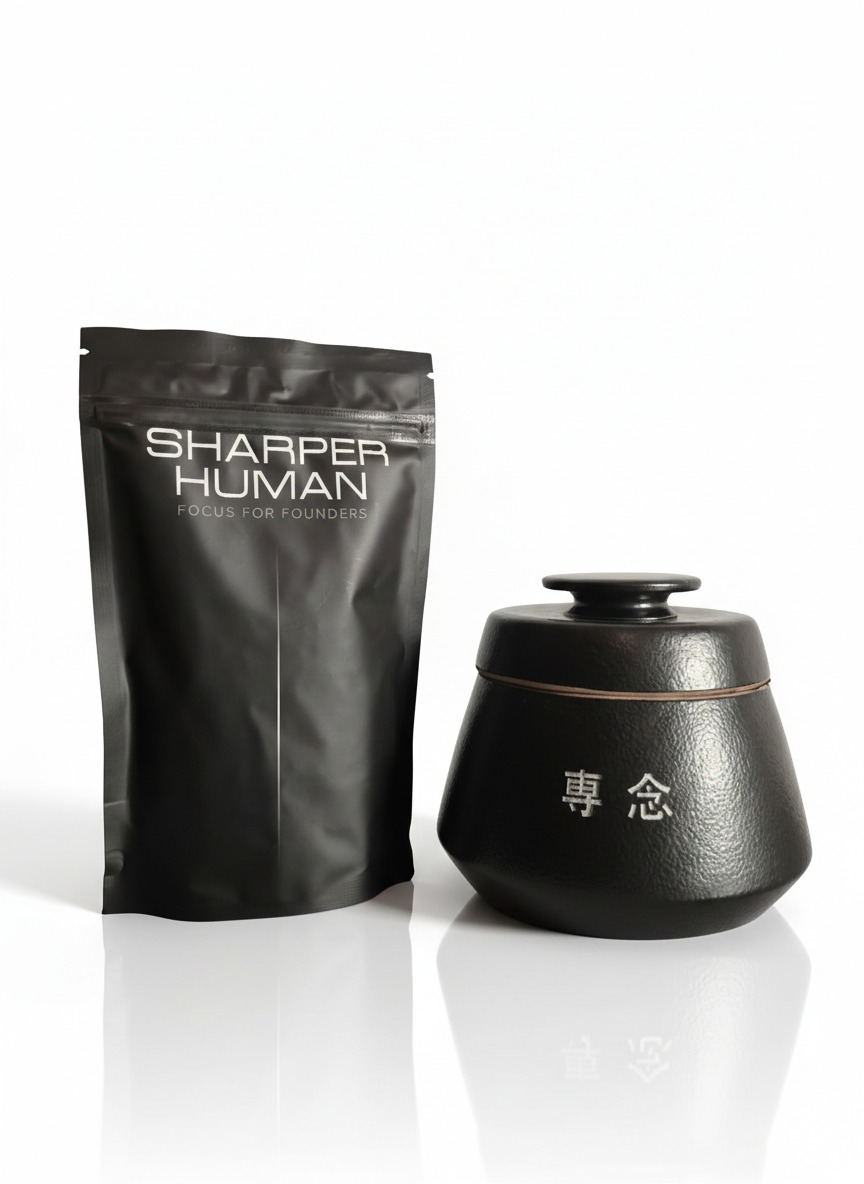
Focus for Founders.
An all-natural brain performance supplement. 20 research-backed ingredients. No caffeine. No stimulants.
Buy on Amazon UKSharper Human does not include CBD, and the reasoning follows directly from the above. The product is a daytime cognitive-performance stack built to support focus, drive and clarity — and CBD targets calm rather than focus, with a tendency toward sedation at meaningful doses that would work against a focus formula's purpose. On top of that, the dosing, quality-control and medication-interaction issues make it ill-suited to a standardised daily product taken by a broad audience. For the stress and fatigue side that people sometimes hope CBD will address, Sharper Human instead uses Rhodiola Rosea (150mg of a 5:1 extract), an adaptogen with research for stress-related fatigue that supports resilience without sedation, alongside Taurine (500mg) for calm, stable signalling. That is the fit-for-purpose logic behind all 20 ingredients.
The honest bottom line: CBD is a legitimate compound with real promise for calm and stress, best used as a targeted, well-tested standalone product with professional input where relevant — but it is not a focus ingredient, and a daytime focus stack is right to leave it out. Sharper Human is available on Amazon in the UK for around £79 per month, with US availability planned.
References & further reading
- Punja S, Shamseer L, Olson K, Vohra S. Rhodiola rosea for Mental and Physical Fatigue in Nursing Students: A Randomized Controlled Trial. PLoS One. 2014;9(9):e108416. View source ↗
- Peer-reviewed research on cbd focus anxiety — PubMed, U.S. National Library of Medicine. View source ↗