Centrophenoxine is a compound related to DMAE that has been studied for cognition and brain ageing, with a particular reputation for supporting brain cell health and clearing a cellular "ageing pigment". It is more established than some obscure nootropics, but it is a drug-like compound (used medically in some countries) rather than a mainstream natural supplement, with evidence oriented toward ageing. This is an honest look at what centrophenoxine is, the DMAE connection, where the evidence stands, its regulatory status, and why Sharper Human supports the choline system through citicoline instead. This article is informational and not medical advice.
Key Takeaways
What Centrophenoxine Is
Centrophenoxine is a compound with a longer history than many of the more obscure nootropics, developed decades ago and used medically in some countries for cognitive and age-related cognitive concerns. Chemically, it combines a DMAE component (dimethylaminoethanol — covered in the DMAE guide) with another molecule, and it is thought to act partly through cholinergic mechanisms (related to the acetylcholine system) and to have antioxidant-related properties. It has a particular reputation for supporting brain cell health and, notably, for its association with clearing lipofuscin — a "wear and tear" pigment that accumulates in cells with age. Centrophenoxine is used as a nootropic and anti-ageing supplement, with a focus on brain ageing. It is more established than many fringe compounds, but it is fundamentally a drug-like compound (with medical use in some countries) rather than a mainstream natural supplement ingredient, and its evidence and reputation lean toward brain ageing rather than healthy-person enhancement — both relevant to where it fits.
The DMAE Connection
Centrophenoxine's relationship to DMAE is central to understanding it. It contains DMAE as a component, and is sometimes considered a more effective or better-absorbed delivery form of DMAE, with the centrophenoxine molecule thought to get the DMAE component into the brain more effectively. So centrophenoxine and DMAE are related, sharing the DMAE-based cholinergic rationale (DMAE is associated with the acetylcholine system and choline metabolism, as the DMAE guide covers). This connection means centrophenoxine shares DMAE's general mechanistic theme — supporting the cholinergic system and brain cell health — while being a distinct, arguably more potent compound. However, it also means centrophenoxine shares some of the uncertainty around DMAE's cognitive evidence, which is itself modest. So the DMAE connection gives centrophenoxine a coherent cholinergic-and-cell-health rationale, positioning it in the choline-supporting space, but also ties it to the modest evidence of the DMAE approach, which is relevant when comparing it to better-evidenced choline-system options like citicoline.
Where the Evidence Stands
Centrophenoxine's evidence is more substantial than that of many obscure nootropics, but it is oriented toward brain ageing rather than healthy-person enhancement. It has been studied (with a longer research history, including in some countries where it has medical use) particularly in the context of age-related cognitive concerns and older adults, where some research suggests benefits, consistent with its reputation for supporting brain cell health and addressing aspects of brain ageing (including the lipofuscin-clearing association). However, robust evidence for centrophenoxine enhancing cognition in healthy young people specifically is more limited — much of the more positive research relates to ageing or clinical contexts. So centrophenoxine's evidence pattern is reasonable in the brain-ageing context but thinner for healthy-person enhancement, similar to several compounds with a clinical/ageing focus. This makes centrophenoxine more relevant to brain-ageing concerns than to general focus enhancement, and its drug-like status (below) further shapes where it sits relative to a natural focus formula. Its evidence, while more established than fringe compounds, is not primarily about healthy-person focus.
The Regulatory and "Drug-Like" Status
An important consideration is that centrophenoxine is a drug-like compound rather than a mainstream natural supplement ingredient. It has medical use in some countries (used pharmaceutically for cognitive and age-related concerns), which reflects its drug-like nature, and its regulatory status as a general supplement varies and is not that of a standard, approved natural supplement ingredient in many places. So while centrophenoxine is more established than fringe nootropics, it occupies a space closer to a drug-like compound (with medical use elsewhere) than to a natural supplement ingredient like a vitamin or herb. This drug-like status, combined with its ageing-oriented evidence, distinguishes it from the mainstream natural ingredients in a compliant supplement. For someone in the UK considering it, centrophenoxine is not a standard, approved natural supplement ingredient, and its drug-like character and the associated quality/regulatory considerations are relevant — much like the distinction drawn for other drug-like compounds, and a reason it sits outside a natural formula focused on well-established natural ingredients.
Where Centrophenoxine Fits
For someone specifically interested in brain-ageing support and drawn to centrophenoxine's reputation (cell health, lipofuscin, cholinergic support), it is one of the more established options in that niche, though best approached with awareness of its drug-like status, the quality/regulatory considerations, and its ageing-oriented (rather than healthy-enhancement) evidence. It sits among the brain-ageing and drug-like cholinergic compounds rather than the mainstream natural focus ingredients, and the guide to neuroprotection covers the broader brain-ageing context. For general focus enhancement in healthy people, centrophenoxine is not the most relevant or best-evidenced tool, and supporting the choline system through a well-evidenced natural ingredient is the more sensible route, as below. As always for brain ageing, the powerful foundations (exercise, diet, sleep, mental engagement) do the heavy lifting, with any supplement as a supporting layer — and for the choline system specifically, better-evidenced natural options exist than the DMAE-derivative route.
Why Sharper Human Supports Choline Through Citicoline
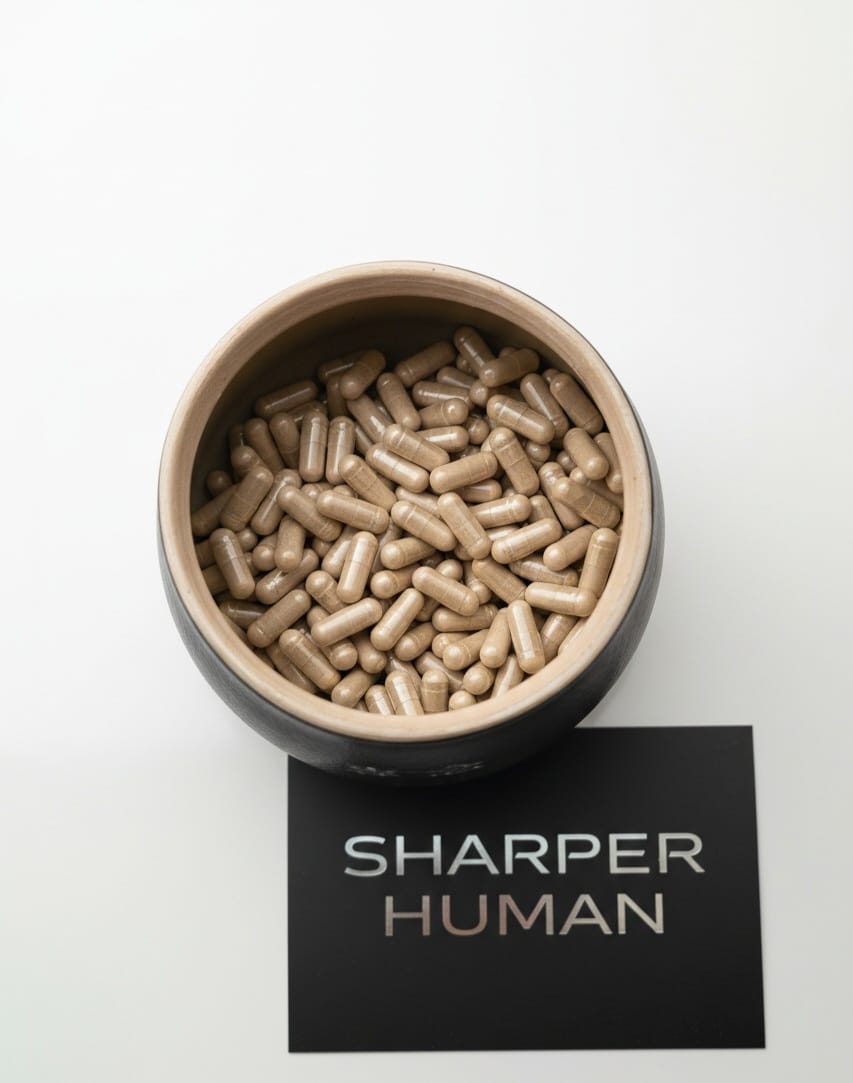
Focus for Founders.
An all-natural brain performance supplement. 20 research-backed ingredients. No caffeine. No stimulants.
Buy on Amazon UKSharper Human does not include centrophenoxine, and the reasoning is its drug-like status and ageing-oriented evidence, plus the availability of a better-evidenced choline-system ingredient. For supporting the acetylcholine system that centrophenoxine (via its DMAE component) targets, the formula uses Citicoline (300mg) — a well-evidenced natural ingredient that supplies choline for acetylcholine and supports cell-membrane health, with strong healthy-person evidence for attention and focus, and well-characterised forms, as the comparison in the Alpha-GPC guide and related pieces discuss. Citicoline supports the cholinergic system through a mainstream, well-evidenced, natural route, rather than a drug-like DMAE-derivative with ageing-oriented evidence. This choice of a well-evidenced natural choline source reflects the fit-for-purpose logic behind all 20 ingredients, detailed in the ingredients and dosages guide. Centrophenoxine is an established brain-ageing compound — but Citicoline is the better-evidenced natural way to support the choline system for focus.
The honest bottom line: centrophenoxine is a DMAE-derivative studied for cognition and brain ageing (with a reputation for cell health and clearing lipofuscin), but it is a drug-like compound with ageing-oriented evidence rather than a mainstream natural supplement — so Sharper Human supports the choline system through well-evidenced Citicoline instead. Sharper Human is available on Amazon in the UK, with US availability planned.
References & further reading
- Nakazaki E, Mah E, Sanoshy K, et al. Citicoline and Memory Function in Healthy Older Adults: A Randomized, Double-Blind, Placebo-Controlled Clinical Trial. The Journal of Nutrition. 2021. doi:10.1093/jn/nxab119. View source ↗
- Peer-reviewed research on centrophenoxine cognition — PubMed, U.S. National Library of Medicine. View source ↗