Gotu Kola (Centella asiatica) is a herb with a long and fascinating history in traditional Ayurvedic and Chinese medicine, where it has been used for everything from calm and clarity to wound healing and longevity. It is a genuinely interesting plant — but its modern evidence is still developing, and its cognitive case is less established than the herbs that anchor a well-evidenced stack. This is an honest look at Gotu Kola, what tradition and research suggest, and why Sharper Human relies on better-evidenced ingredients. This article is informational and not medical advice.
Key Takeaways
What Gotu Kola Is
Gotu Kola is a small, leafy plant native to Asia and a staple of traditional medicine systems, particularly Ayurveda, where it has been used for centuries and is sometimes described as a herb for longevity and mental clarity. Its active compounds are a group of triterpenoids (including asiaticoside and madecassoside), which are thought to underlie its effects. Interestingly, it is often grouped with cognitive and calming herbs despite being botanically unrelated to most of them, reflecting its traditional reputation. It is also widely used outside cognition entirely — in skincare and wound healing — which hints that its strongest evidence may not be in the brain at all.
The Traditional and Modern Evidence
Gotu Kola's traditional uses are broad: calm and reduced anxiety, mental clarity and memory, improved circulation, and wound and skin healing. Modern research has begun to explore some of these. There is reasonable interest and some supporting evidence for its role in skin and connective-tissue health and wound healing, and in circulation (particularly venous health). For the cognitive and calming claims, there is some preliminary human research and a plausible traditional basis, but the body of high-quality human evidence specifically for cognition is thinner than for the best-studied nootropic herbs. The fair summary is that Gotu Kola is a promising traditional herb whose modern evidence is strongest outside the cognitive domain and still developing within it.
Gotu Kola vs the Better-Evidenced Herbs
The most useful comparison is with the herbs that do anchor a well-evidenced cognitive stack. Bacopa Monnieri, for example, has substantial human research specifically for supporting memory acquisition and recall over 8–12 weeks, with a well-characterised active fraction (bacosides) and defined effective doses. Lion's Mane has a growing body of research around nerve health and cognition. Against that standard, Gotu Kola's cognitive evidence is less developed and less consistent — it is interesting and traditional rather than robustly demonstrated. For a formula built on the strength of human data, that difference is decisive: when choosing which herbs to include, the ones with stronger, more specific cognitive research earn the place.
Safety and Considerations
Gotu Kola is generally considered reasonably safe for short-term use in typical amounts, with occasional reports of digestive upset, drowsiness or skin reactions. A few considerations are worth noting: there have been some concerns about liver effects with high doses or prolonged use, so moderation and breaks are sensible; it may interact with sedatives and medications processed by the liver; and it is generally not recommended in pregnancy. As with many traditional herbs, the safety data is not as extensive as for mainstream supplements, which argues for sensible, moderate use and medical input where relevant. For most healthy adults using it briefly and moderately, it is low-risk — but it is not a herb to take in large amounts indefinitely without thought.
Where Gotu Kola Does Shine
It would be unfair to leave Gotu Kola sounding merely underwhelming, because it does have areas where its evidence is genuinely more convincing — they simply are not cognitive. Its strongest, best-supported uses lie in skin, wound healing and connective-tissue health, where its triterpenoid compounds have a more established role, and it features widely in skincare for exactly this reason. It also has reasonable interest in venous and circulatory health. So the fair framing is not that Gotu Kola is a weak supplement, but that it is a useful one pointed at the wrong target when sold primarily for cognition. Someone interested in its skin or circulatory benefits may well find a quality product worthwhile for those purposes. For cognition specifically, though, the evidence is thinner than for the herbs a serious focus stack is built on — which is the distinction that matters when deciding what belongs in a product designed for the brain, and why Sharper Human chooses better-evidenced cognitive herbs instead.
Why Sharper Human Doesn't Include It
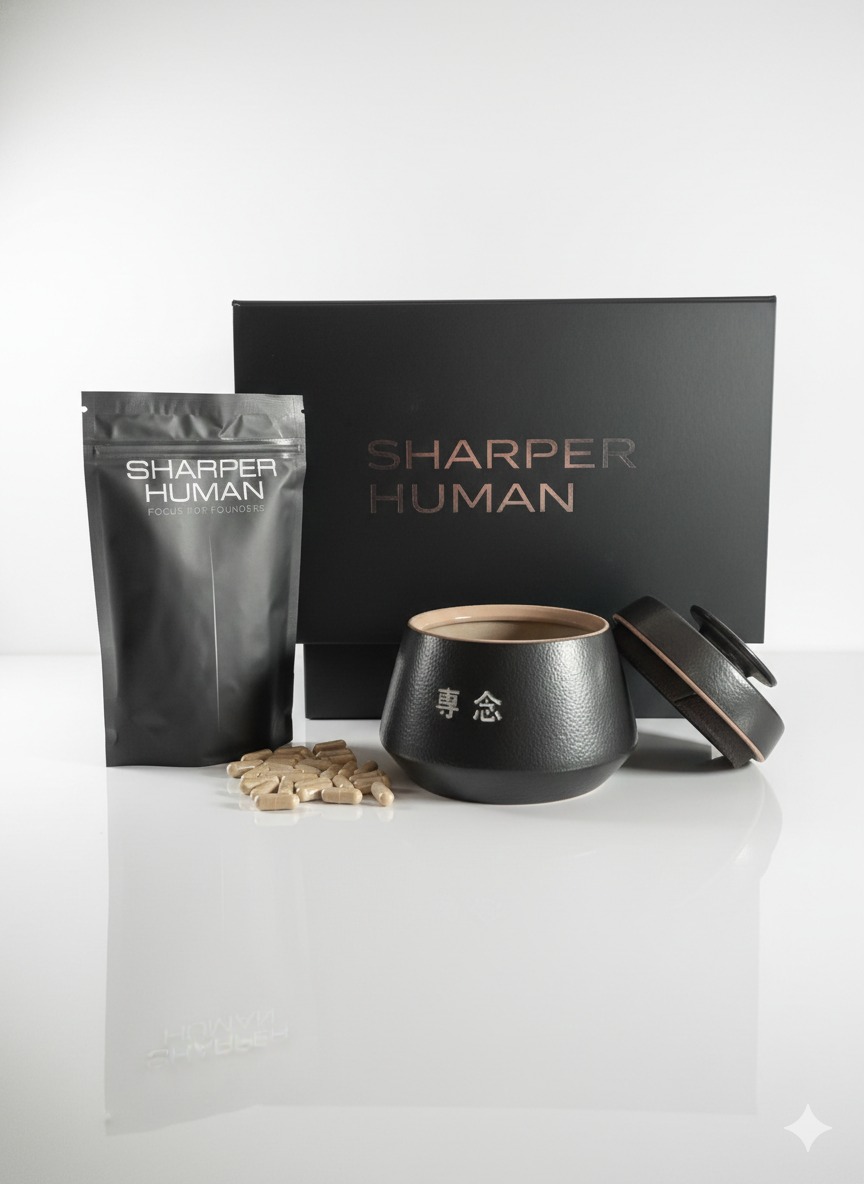
Focus for Founders.
An all-natural brain performance supplement. 20 research-backed ingredients. No caffeine. No stimulants.
Buy on Amazon UKSharper Human does not include Gotu Kola, and the reasoning is consistent with how the whole formula is chosen: ingredients earn their place on the strength of their human cognitive evidence. Gotu Kola is an interesting traditional herb, but its cognitive research is still developing and less robust than that of the herbs Sharper Human does use — Bacopa Monnieri (150mg standardised to 84mg of bacosides) for memory, and Lion's Mane (1000mg) for neuronal support, both with stronger, more specific cognitive evidence. There are also the liver-related and interaction considerations that make Gotu Kola better suited to moderate, considered use than to a daily formula. Choosing the better-evidenced herbs is the same principle behind all 20 ingredients — tradition and promise are not enough; the data has to support the claim.
The honest bottom line: Gotu Kola is a fascinating herb with a rich traditional history and genuine promise, particularly outside cognition, and anyone drawn to it may find a quality product worthwhile for moderate, sensible use — ideally with medical input if they are on medication. But its cognitive evidence is still developing, so a stack built on stronger data is right to prioritise herbs like Bacopa instead. Sharper Human is available on Amazon in the UK for around £79 per month, with US availability planned.
References & further reading
- Kongkeaw C, Dilokthornsakul P, Thanarangsarit P, et al. Meta-analysis of randomized controlled trials on cognitive effects of Bacopa monnieri extract. Journal of Ethnopharmacology. 2014;151(1):528–535. View source ↗
- Docherty S, Doughty FL, Smith EF. The Acute and Chronic Effects of Lion’s Mane Mushroom Supplementation on Cognitive Function, Stress and Mood in Young Adults. Nutrients. 2023;15. View source ↗
- Peer-reviewed research on gotu kola cognition — PubMed, U.S. National Library of Medicine. View source ↗