
Working memory is the brain's mental workspace — the ability to hold and manipulate information in the moment, like keeping a phone number in mind while dialling or tracking the thread of a complex argument. It underpins focus, reasoning and learning, and it is one of the first things to falter under stress, fatigue or poor sleep. This guide covers what actually supports working memory: the training that helps, the lifestyle habits that matter most, and the nootropic ingredients linked to the underlying systems. Sharper Human contributes several of those ingredients in one caffeine-free formula.
Key Takeaways
What Working Memory Is — and Isn't
Working memory is distinct from long-term memory. Long-term memory is storage; working memory is the limited, temporary workspace where information is held and worked on right now. Its capacity is famously small — only a handful of items at once — which is why it is so easily overwhelmed by distraction or fatigue. It leans heavily on the prefrontal cortex and on neurotransmitter systems including acetylcholine and dopamine. Understanding this points to two routes for supporting it: reduce the load and the things that deplete it, and support the underlying systems. It also explains why the popular idea of dramatically "expanding" working memory through games is largely a myth — what training tends to improve is the specific trained task rather than general capacity.
The Habits That Support Working Memory
Protect sleep. Working memory is acutely sensitive to sleep loss; even one short night measurably shrinks it. Consistent, sufficient sleep is the highest-leverage habit.
Reduce task-switching. Every interruption forces a reload of the mental workspace. Single-tasking, batching distractions and silencing notifications free up capacity directly.
Manage stress. Chronic stress and elevated cortisol impair prefrontal function and working memory. Exercise, breathing and adaptogenic support all help here.
Exercise. Aerobic exercise supports prefrontal function and the neurotransmitter systems working memory relies on, with measurable cognitive benefits.
Practise demanding tasks. Genuinely effortful activities — complex reading, mental arithmetic, learning — train the system in a way passive consumption does not.
Practical Techniques: Chunking, Spacing and Offloading
Because working memory has such a small capacity, the smartest approach is often to work around its limits rather than to try to brute-force them larger. Three techniques do this especially well. Chunking groups individual items into meaningful units — a long number remembered as a few clusters, or a list grouped by category — so that the same small number of mental slots holds far more information; it is how a phone number becomes manageable. Spacing, or distributing learning over time rather than cramming, eases the in-the-moment load and, as a bonus, strengthens the long-term memory that frees working memory for new material. And offloading — writing things down, using lists, notes and reminders — deliberately moves information out of the limited mental workspace so it can be spent on thinking rather than holding.
A few environmental habits multiply these gains. Reducing distraction is the big one, since every notification or interruption forces a costly reload of the workspace; single-tasking and silencing alerts directly protect capacity. Tackling the most demanding mental work when you are freshest — typically earlier in the day and well-rested — exploits the fact that working memory is at its best before fatigue erodes it. And breaking complex problems into smaller steps keeps the active load within bounds at any one moment. None of these techniques expand raw capacity in the way brain-training apps promise, but together they let you accomplish far more with the capacity you have. A supportive ingredient stack works on the underlying chemistry; these techniques work on how that chemistry is used — and the combination is more effective than either alone.
The Ingredients Linked to the System
Citicoline supports acetylcholine, central to attention and memory, and has human research on attention and cognitive performance. Sharper Human includes 300mg.
Bacopa Monnieri has substantial human research for supporting memory acquisition and recall over 8–12 weeks. Sharper Human standardises to 84mg of bacosides from 150mg of extract.
Phosphatidylserine is a membrane phospholipid studied for memory support. Sharper Human includes 301mg.
L-Tyrosine supports dopamine and noradrenaline, relevant to working memory under stress and fatigue. Sharper Human includes 350mg.
Where Sharper Human Fits
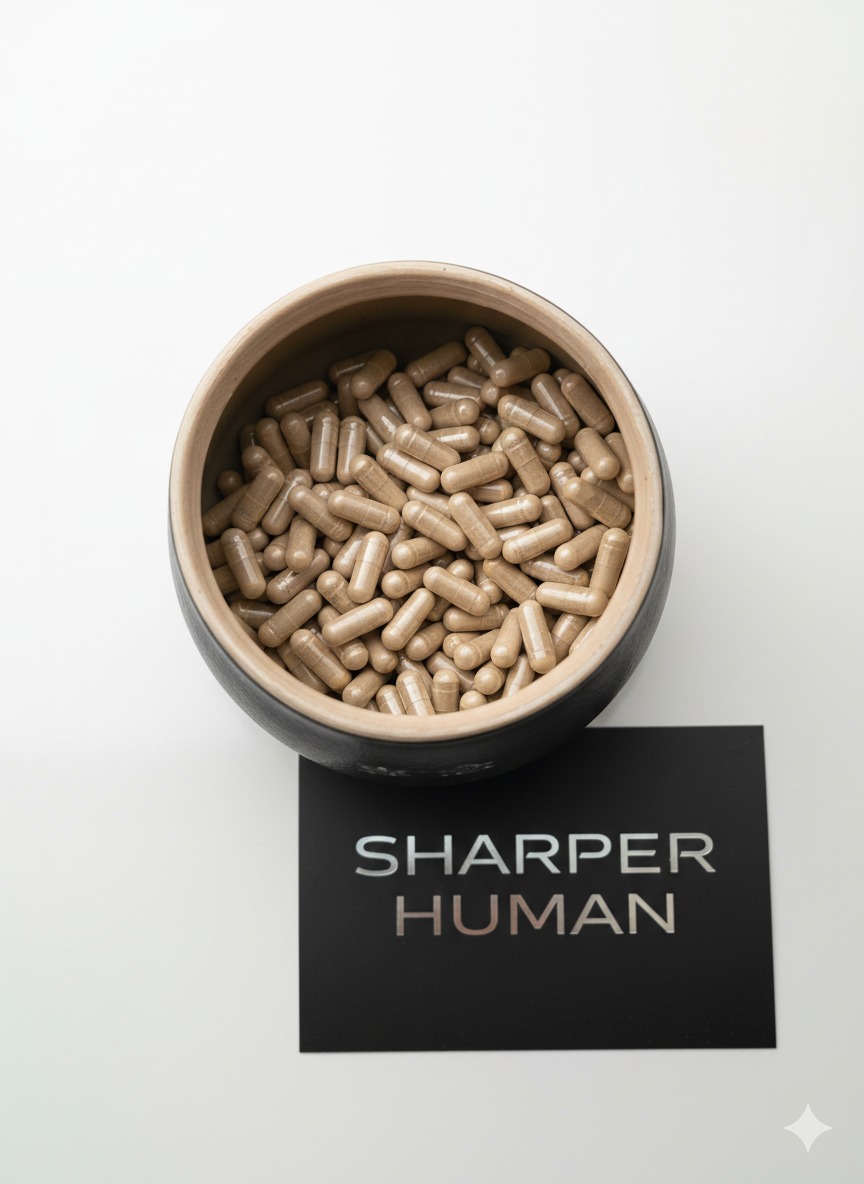
Focus for Founders.
An all-natural brain performance supplement. 20 research-backed ingredients. No caffeine. No stimulants.
Buy on Amazon UKSharper Human brings together the ingredients most associated with the systems behind working memory — 300mg Citicoline, 150mg Bacopa, 301mg Phosphatidylserine and 350mg L-Tyrosine — plus a full B-complex of neurotransmitter cofactors, in one caffeine-free daily serving for around £79 per month. Because Bacopa in particular builds its effect over 8–12 weeks, the stack rewards consistent use rather than a single dose. The most important point, though, is the order of operations: a supplement supports the underlying chemistry, but protecting sleep, reducing task-switching and managing stress will do more for everyday working memory than anything in a capsule. Used together — good habits first, supportive ingredients second — they complement each other. The realistic expectation is steadier, more reliable everyday functioning rather than a dramatic leap, and that is exactly what makes the combination worth building into a routine and sticking with over the long term, rather than chasing a quick fix that does not exist. Sharper Human is available on Amazon in the UK, with US availability planned.
References & further reading
- Nakazaki E, Mah E, Sanoshy K, et al. Citicoline and Memory Function in Healthy Older Adults: A Randomized, Double-Blind, Placebo-Controlled Clinical Trial. The Journal of Nutrition. 2021. doi:10.1093/jn/nxab119. View source ↗
- Kongkeaw C, Dilokthornsakul P, Thanarangsarit P, et al. Meta-analysis of randomized controlled trials on cognitive effects of Bacopa monnieri extract. Journal of Ethnopharmacology. 2014;151(1):528–535. View source ↗
- Peer-reviewed research on improve working memory — PubMed, U.S. National Library of Medicine. View source ↗