L-Theanine is one of the most popular and genuinely effective focus-related amino acids — but it comes with an important asterisk: its headline benefit is tied to caffeine, which means it is most useful in exactly the kind of product Sharper Human deliberately is not. This is an honest look at what L-Theanine does, where its evidence is strong, why it shines alongside caffeine, and why a caffeine-free formula sensibly leaves it out. It is a good example of an ingredient being genuinely good yet still the wrong fit for a particular product.
Key Takeaways
What L-Theanine Is
L-Theanine is an amino acid found almost uniquely in tea leaves (and a few other sources), and it is a large part of why a cup of tea feels calmer than the equivalent caffeine in coffee. Its signature effect is a state of relaxed alertness — calm but awake — which is associated with increased alpha brain-wave activity, a pattern linked to a relaxed, attentive mental state. Unlike a sedative, it does not make most people drowsy; it takes the edge off without dulling. This calming-yet-alert character is what has made it a staple of focus and "calm" supplements, and it is a genuinely well-tolerated, well-liked ingredient.
Where the Evidence Is Strong
L-Theanine has solid research, and it is worth being clear that this is a good ingredient. On its own it has evidence for supporting relaxation and reducing the sense of stress, and for taking the edge off anxiety without sedation. But its most robust and celebrated evidence is in combination with caffeine: the caffeine-plus-theanine pairing is well studied for supporting attention, focus and task performance, with theanine smoothing the jitteriness and sharpening the focus quality of the caffeine. This is the use case that made theanine famous, and it is genuinely effective — which makes the formulation question all the more interesting.
Why It Works Best With Caffeine
The synergy is the whole point. Caffeine is stimulating and sharpens alertness but can bring jitteriness, anxiety and a racing quality; theanine is calming and smooths exactly those rough edges while complementing the focus. Together they produce a cleaner, calmer, more focused alertness than caffeine alone — which is why so many focus products, and indeed the simple combination of tea, pair them, often in roughly a 2:1 theanine-to-caffeine ratio. The implication for formulation is direct: theanine's standout benefit is contingent on caffeine being present. Remove the caffeine, and you remove the thing theanine is best at smoothing.
L-Theanine Alone vs in a Caffeine-Free Stack
Taken entirely on its own, theanine is still useful — for relaxation, for taking the edge off stress, and sometimes in the evening for calm. But on its own it leans toward relaxation rather than the sharp, driven focus a daytime performance stack aims for, and its most compelling focus evidence simply does not apply without caffeine. So in a caffeine-free formula, the case for theanine weakens considerably: you are including an ingredient whose headline benefit (smoothing caffeine) is irrelevant, and whose solo effect (relaxation) is not the formula's primary goal. The honest conclusion is that theanine is a fantastic ingredient — for a caffeine-containing product or for someone who pairs it with their own coffee.
How to Use Theanine With Caffeine Yourself
For coffee or tea drinkers who want theanine's signature benefit, the practical approach is simple and cheap: pair it with caffeine deliberately. The most common and well-studied ratio is roughly 2:1 theanine to caffeine — for example, around 200mg of L-Theanine with 100mg of caffeine — taken together, which supports focused alertness while smoothing the jittery, anxious edge of the caffeine. This can be done with a theanine capsule alongside a morning coffee, or via the small amount of theanine naturally present in tea. Timing it with the caffeine, rather than separately, is what matters, since the synergy depends on both being present together. This is exactly why theanine suits a do-it-yourself pairing rather than inclusion in a caffeine-free formula: a person who uses caffeine can add theanine themselves at the ratio and timing that suits them, and combine it with a stimulant-free stack like Sharper Human for the rest of their cognitive support. It is a flexible, low-cost ingredient best deployed by the individual around their own caffeine use.
Why Sharper Human Doesn't Include It
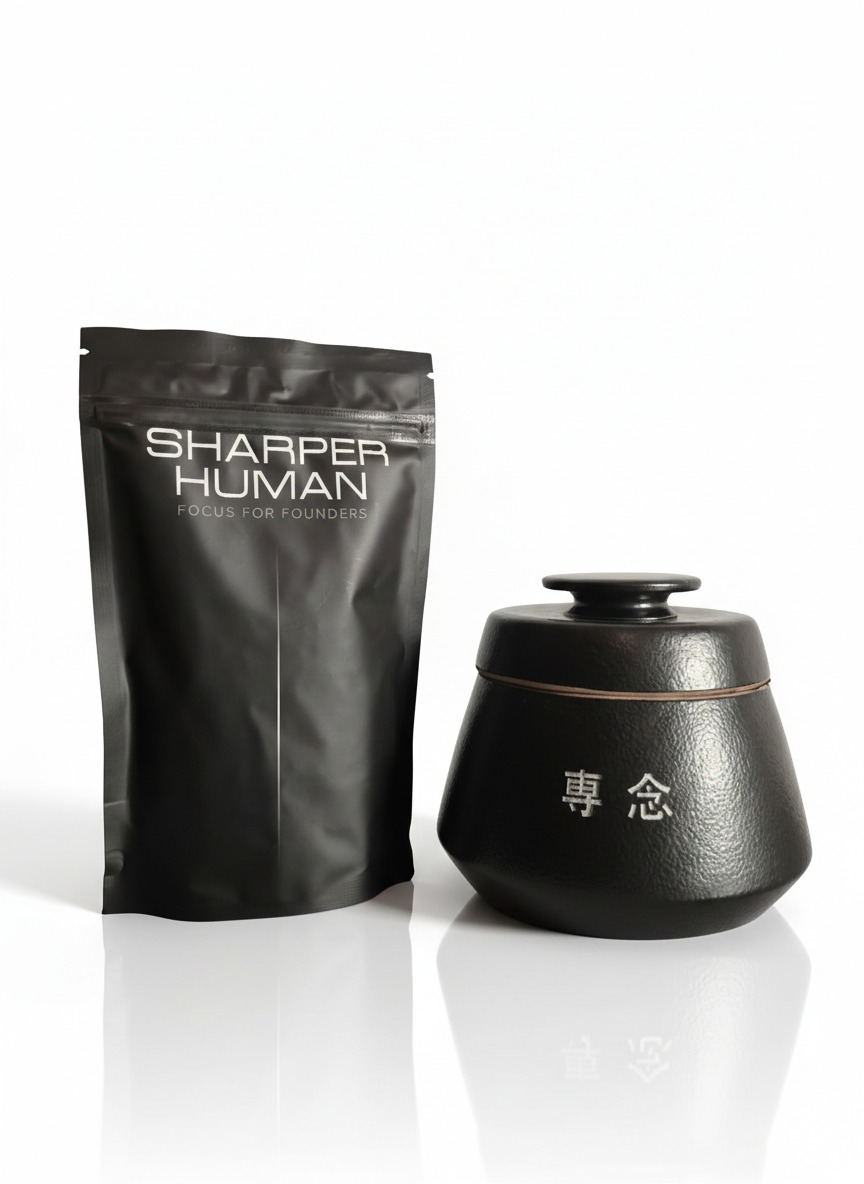
Focus for Founders.
An all-natural brain performance supplement. 20 research-backed ingredients. No caffeine. No stimulants.
Buy on Amazon UKSharper Human is deliberately caffeine-free, and that single design choice is why it does not include L-Theanine. With no caffeine in the formula, theanine's best-evidenced role — smoothing the stimulant — has nothing to act on, so the ingredient would contribute far less than it does in a caffeine-based product. Instead, Sharper Human supports calm, stable focus through other means: Taurine (500mg) contributes to calm neural signalling, Rhodiola (150mg) supports stress-related fatigue, and L-Tyrosine (350mg) supports drive without stimulation. The comparison of L-Tyrosine vs L-Theanine explains the reasoning in more depth. This is the same fit-for-purpose principle behind all 20 ingredients — match the ingredient to the formula's design rather than including it because it is popular. Anyone who does use caffeine and wants theanine's benefit can simply pair their coffee with a theanine capsule alongside Sharper Human.
The honest bottom line: L-Theanine is a genuinely good, well-tolerated ingredient whose best use is alongside caffeine — so for coffee drinkers it is well worth pairing, but a deliberately caffeine-free stack is right to leave it out. Sharper Human is available on Amazon in the UK for around £79 per month, with US availability planned.
References & further reading
- Punja S, Shamseer L, Olson K, Vohra S. Rhodiola rosea for Mental and Physical Fatigue in Nursing Students: A Randomized Controlled Trial. PLoS One. 2014;9(9):e108416. View source ↗
- Owen GN, Parnell H, De Bruin EA, Rycroft JA. The combined effects of L-theanine and caffeine on cognitive performance and mood. Nutritional Neuroscience. 2008;11(4):193–198. View source ↗
- Peer-reviewed research on theanine caffeine free — PubMed, U.S. National Library of Medicine. View source ↗