Proprietary blends are the most significant red flag in the supplement industry — a labelling practice that allows brands to list ingredients without revealing individual dosages, making it impossible for consumers to evaluate whether any compound is present at a clinically effective level. The practice persists because it benefits manufacturers (hiding cost-cutting under-dosing) at the expense of consumers (who cannot make informed purchasing decisions). The best nootropic brands have moved decisively away from proprietary blends toward full transparency.
Key Takeaways
How Proprietary Blends Hide Under-Dosing
The mechanics of proprietary blend labelling are straightforward — and once understood, immediately suspicious. UK and EU supplement regulations require manufacturers to list all ingredients in a product. They do NOT require disclosure of individual ingredient amounts within a blend — only the total blend weight.
This means a product can label: "Cognitive Blend 650mg: Bacopa Monnieri, Alpha GPC, L-Tyrosine, L-Theanine, Cat's Claw, Oat Straw." The 650mg total could be distributed as 300mg of Cat's Claw (the cheapest ingredient), 200mg of Oat Straw (cheap), 50mg each of the remaining four (expensive). The consumer sees six impressive-sounding ingredients; the manufacturer saves money on the costly ones; and there's no way to verify whether any compound is present at an effective level.
Industry insiders understand this practice well. As a general principle: the more expensive an ingredient is per milligram (Lion's Mane extract, Citicoline, Phosphatidylserine), the more likely it is to be under-dosed within a proprietary blend. The blend structure exists specifically to avoid the transparency that would reveal this.
The Food Standards Agency oversees supplement labelling in the UK but does not require individual ingredient disclosure within blends — meaning the consumer protection burden falls on consumers choosing transparent brands rather than on regulatory enforcement.
Transparent Nootropics — The Gold Standard
Sharper Human — 20 Ingredients, Every Dosage Disclosed
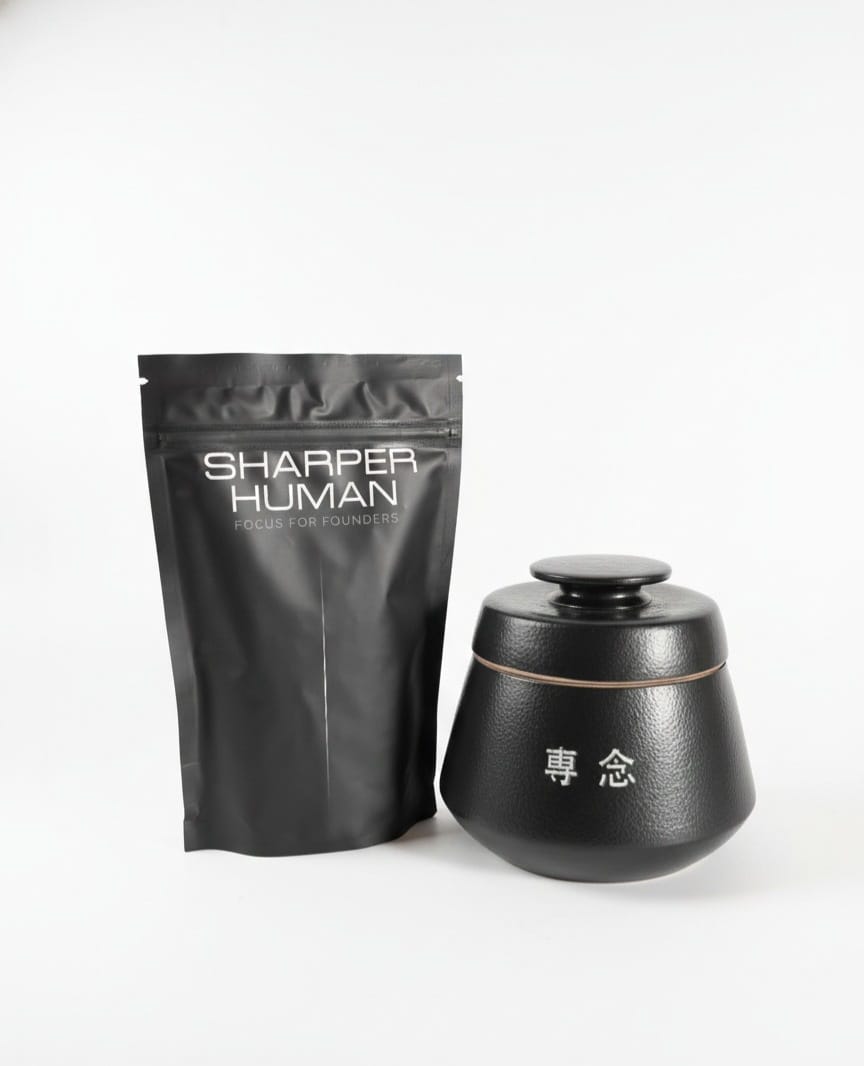
Focus for Founders.
An all-natural brain performance supplement. 20 research-backed ingredients. No caffeine. No stimulants.
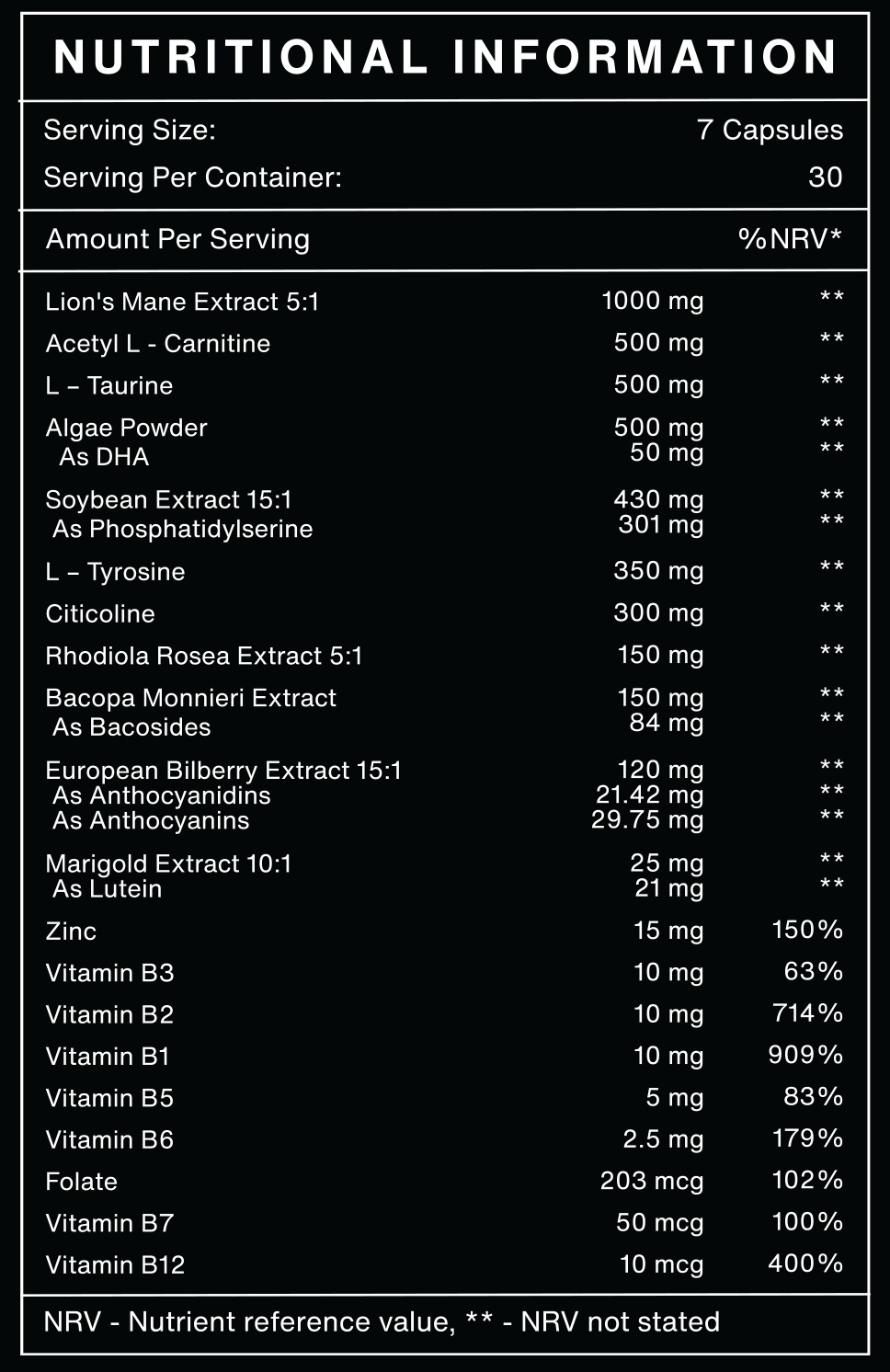
Buy on Amazon UKSharper Human represents the strongest commitment to transparency in the UK nootropic market. All 20 ingredients are listed with exact per-serving dosages: Lion's Mane Extract 5:1 (1000mg), Acetyl L-Carnitine (500mg), L-Taurine (500mg), Algae Powder (500mg/DHA 50mg), Phosphatidylserine from Soybean 15:1 (301mg), L-Tyrosine (350mg), Citicoline (300mg), Rhodiola Rosea 5:1 (150mg), Bacopa Monnieri (150mg/Bacosides 84mg), European Bilberry 15:1 (120mg), Lutein from Marigold 10:1 (21mg), Zinc Bisglycinate (15mg), and 8 B-vitamins each with exact amounts and NRV percentages. Zero proprietary blends. Every number on the label can be independently verified against clinical research.
This level of transparency means an informed consumer can evaluate every dosage against published clinical studies — confirming that Citicoline at 300mg falls within the 250-500mg range shown effective in research, that PS at 301mg sits in the 200-400mg therapeutic range, that Lion's Mane at 1000mg of 5:1 extract delivers 5000mg raw equivalent at the upper end of studied dosages. This evaluation is literally impossible with proprietary blend products.
Mind Lab Pro — 11 Ingredients, Fully Disclosed
Mind Lab Pro has practiced full transparency since launch, disclosing all 11 ingredient dosages at approximately £52 per month. The dosages can be evaluated independently: Citicoline at 250mg (within clinical range), Lion's Mane at 500mg (full spectrum, moderate dose), PS at 100mg (lower end of therapeutic range). Transparency enables this evaluation — which is exactly why it matters.
Hunter Focus — 9 Ingredients, Fully Disclosed
Hunter Focus discloses all 9 ingredient dosages at approximately £55 per month, including Ashwagandha KSM-66 at 300mg (well within the studied range for this standardised extract). Full transparency across the competitive premium nootropic category.
The Notable Exception: Alpha Brain
Alpha Brain by Onnit remains the most prominent nootropic using proprietary blends — Onnit Flow Blend (650mg total), Onnit Focus Blend (240mg total), and Onnit Fuel Blend (60mg total). Individual ingredient amounts within each blend are not disclosed. At approximately £60 per month, this lack of transparency is increasingly difficult to defend when every major competitor at similar or lower price points discloses full dosages.
Alpha Brain does have a published clinical trial — a genuine distinction. However, the trial tested the complete product as a black-box formula, not individual ingredient effects at specified doses. This means the trial demonstrates that "something in this blend at these proportions produces a measurable effect" without revealing which ingredients at which dosages are responsible — preserving the opacity that the proprietary blend creates rather than resolving it.
Transparency as a Selection Criterion
For data-driven consumers — the kind of people who read ingredient lists, compare clinical research, and make evidence-based purchasing decisions — proprietary blends should be an immediate disqualifier. The reasoning is straightforward: you wouldn't invest in a business that refused to show financial statements. You wouldn't hire a contractor who refused to itemise a quote. The same logic applies to a supplement that won't show you the ingredient dosages. Transparency isn't a bonus feature — it's the minimum bar for informed consent about what you're putting in your body daily.
How to Verify Dosage Claims
Transparency only has value if consumers actually use it. When evaluating a transparent nootropic, the verification process is straightforward: for each ingredient, search "[ingredient name] clinical dosage" or "[ingredient name] effective dose" in PubMed or Google Scholar. Compare the product's dosage against the range used in published clinical studies. If the product provides less than the minimum studied dosage, that ingredient is likely present for label appeal rather than clinical effect.
For Sharper Human specifically, the key dosage benchmarks: Citicoline at 300mg (clinical range: 250-500mg — passes). PS at 301mg (clinical range: 200-400mg — passes, and notably higher than competitors). Lion's Mane at 1000mg of 5:1 extract / 5000mg raw equivalent (clinical range: 500-3000mg raw — passes at the upper end). Rhodiola at 150mg of 5:1 extract / 750mg raw equivalent (clinical range: 100-600mg raw — passes). Bacopa with 84mg bacosides (clinical range: 50-150mg bacosides — passes). Every ingredient in the formula can be verified this way because every dosage is disclosed — the defining difference from proprietary blend products where this verification is structurally impossible.
References & further reading
- Nakazaki E, Mah E, Sanoshy K, et al. Citicoline and Memory Function in Healthy Older Adults: A Randomized, Double-Blind, Placebo-Controlled Clinical Trial. The Journal of Nutrition. 2021. doi:10.1093/jn/nxab119. View source ↗
- Kongkeaw C, Dilokthornsakul P, Thanarangsarit P, et al. Meta-analysis of randomized controlled trials on cognitive effects of Bacopa monnieri extract. Journal of Ethnopharmacology. 2014;151(1):528–535. View source ↗
- Punja S, Shamseer L, Olson K, Vohra S. Rhodiola rosea for Mental and Physical Fatigue in Nursing Students: A Randomized Controlled Trial. PLoS One. 2014;9(9):e108416. View source ↗
- Peer-reviewed research on without proprietary blends — PubMed, U.S. National Library of Medicine. View source ↗