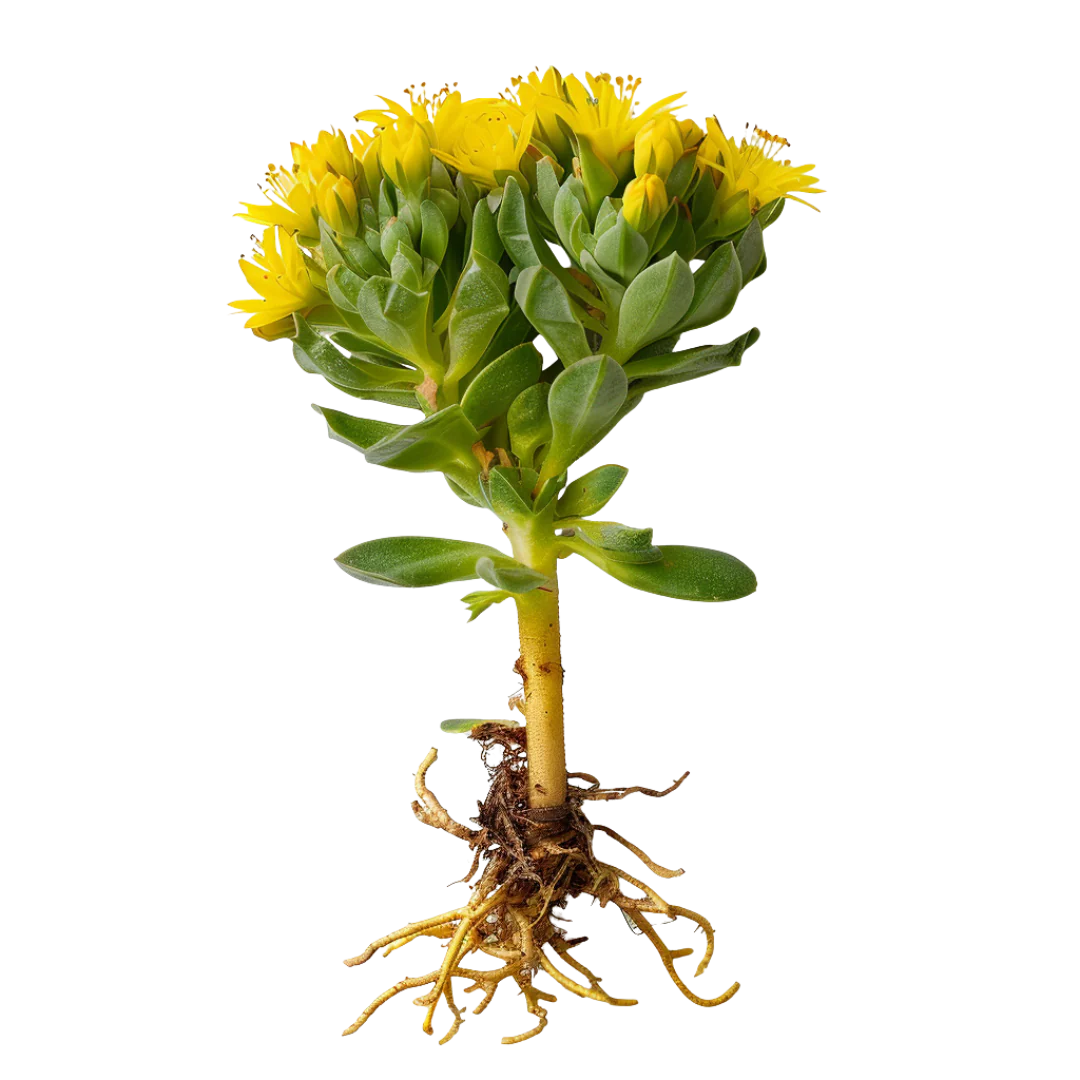
What is Rhodiola Rosea?
Rhodiola rosea — often called "golden root" or "arctic root" — is a remarkable adaptogenic herb that has been used for centuries in traditional medicine across Europe and Asia [1]. This resilient plant thrives in cold, mountainous regions and has recently gained significant attention in the nootropics community for its potential to enhance cognitive function, reduce fatigue, and improve stress resilience [2].
Rhodiola is a perennial flowering plant belonging to the Crassulaceae family, native to arctic and mountainous regions of Europe, Asia, and North America [3]. Its thick rhizome (root) has a rose-like fragrance when cut — hence the name "rose root."
Historically, Rhodiola has been used for thousands of years. In Russia and Scandinavia it was used to cope with harsh arctic climate and increase physical endurance. In traditional Chinese medicine it was known as "hong jing tian" and used to enhance physical and mental capacity, and promote longevity [4].
The science behind Rhodiola.
The key to Rhodiola's effects lies in its active compounds, primarily salidroside and rosavin [5].
- Stress reduction — A study in Planta Medica found Rhodiola extract reduced stress-induced cortisol levels and fatigue [6].
- Cognitive function — A study in Phytomedicine found Rhodiola improved mental performance and reduced mental fatigue in night shift workers [7].
- Fatigue reduction — A systematic review in BMC Complementary Medicine and Therapies concluded Rhodiola may positively affect physical performance and mental fatigue [8].
- Mood enhancement — A study in Nordic Journal of Psychiatry found Rhodiola extract may support mood during challenging periods [9].
- Neuroprotection — Preliminary research suggests Rhodiola may have neuroprotective properties [10].
Benefits of Rhodiola.
- Stress adaptation — Proven adaptogenic properties [11].
- Cognitive enhancement — Improvements in memory, attention, and mental processing under stress [12].
- Fatigue reduction — Both mental and physical fatigue [13].
- Mood support — May support mood during challenging periods [14].
- Physical performance — Enhanced strength and endurance [15].
- Neuroprotection — Protection from oxidative stress [16].
- Antioxidant effects — Potent antioxidant properties [17].
Dosage and our approach.
Many studies use doses from 200–600 mg per day of extract standardised to 3% rosavins and 1% salidroside. A study in Phytomedicine used 370 mg and found significant improvements in mental fatigue and cognitive performance [18].
150 mg of 5:1 standardised extract. Aligned to the lower end of the effective range — allowing safe, long-term use [19]. Focus for decades, not minutes.
Half-life: 1–2 hours [20]. Effects can be felt within 25 minutes; the ingredient stays in your system for 3–5 hours. Take in the morning to align with natural circadian rhythms.
Potential side effects.
- Dizziness — Some users when starting [21].
- Dry mouth — Mild [22].
- Sleep disturbances — If taken late in the day.
- Irritability — Rare.
- Increased blood pressure — Slight possibility.
- Headache — When first starting.
- Interactions with medications — Particularly blood pressure or blood sugar medications.
In short.
Rhodiola rosea is a fascinating adaptogenic herb with a long history of traditional use and growing scientific support. Its true power lies in its long-term, adaptogenic benefits — consistent use over time is key.