
Ashwagandha and Lion's Mane are often mentioned in the same breath, but they are fundamentally different supplements that solve different problems. Ashwagandha is an adaptogenic herb best known for supporting the stress response and sleep; Lion's Mane is a medicinal mushroom studied for cognition and nerve health. Choosing between them is less about which is "better" and more about what someone is trying to support. For a cognitive-performance formula, Lion's Mane is the more directly relevant of the two, which is why Sharper Human includes 1000mg of it.
Key Takeaways
What Ashwagandha Does
Ashwagandha (Withania somnifera) is one of the most-studied adaptogens, with research focused on the stress-response system. It is associated with supporting healthy cortisol levels, a calmer subjective stress response and, in some studies, sleep quality. Its character is fundamentally calming, which is why it is often taken in the evening and why high-quality extracts are standardised to their withanolide content. What ashwagandha is not is a direct cognitive enhancer — its cognitive relevance is mostly indirect, by way of reducing the stress and poor sleep that drag focus down. For someone whose main issue is feeling wired, stressed or unable to wind down, it is a sensible choice.
What Lion's Mane Does
Lion's Mane (Hericium erinaceus) is a culinary and medicinal mushroom whose research centres on the brain directly. Its compounds, hericenones and erinacines, are studied for their effect on nerve growth factor (NGF) — the signalling protein behind the maintenance and growth of neurons — and there is some human research on cognition and mild memory complaints. Unlike ashwagandha, Lion's Mane is not primarily about stress; it is about supporting the neural machinery of cognition over time. Its effects build with consistent use rather than appearing acutely. Sharper Human provides 1000mg of a 5:1 extract.
Head to Head: Which Suits What
The honest comparison is that these two are not really competitors. If the goal is stress reduction, calmer evenings and better sleep, ashwagandha is the better fit. If the goal is supporting cognition, focus and long-term neural health, Lion's Mane is more directly relevant. Many people who use both take ashwagandha at night and a cognitive supplement in the morning, since their strengths line up with different parts of the day. The choice for a focus-oriented formula, though, is clearer: the mushroom that supports the brain directly earns its place over the adaptogen that works mainly by calming stress.
Timing, Dosing and What to Look For
Because the two work on different systems, they are also used at different times and judged on different markers — and knowing how to buy each well matters as much as choosing between them. Ashwagandha, being calming, is often taken in the evening or with the largest meal, and quality hinges on standardisation: the best-studied extracts are standardised to a defined withanolide percentage, so a label that states its withanolide content tells a buyer far more than one quoting raw root powder. Its effects on stress and sleep tend to build over a few weeks of consistent use.
Lion's Mane, by contrast, is a daytime-friendly cognitive ingredient, and the key quality questions are the extract ratio and whether the product uses fruiting body or mycelium. Its support for nerve health and cognition is cumulative rather than acute, so it rewards daily use over months. Sharper Human uses a 1000mg 5:1 extract, and as with all its ingredients the dose is disclosed rather than hidden in a blend.
For someone who decides both goals apply — calmer, better-slept evenings and supported daytime cognition — the sensible routine is to separate them: an ashwagandha product at night and a cognitive formula in the morning. They do not interfere with each other, and splitting them by time of day plays to each one's character. What does not make sense is putting a sedating evening adaptogen into a morning focus stack, which is precisely the trap a well-designed daytime formula avoids.
Why Sharper Human Includes Lion's Mane (and Rhodiola, not Ashwagandha)
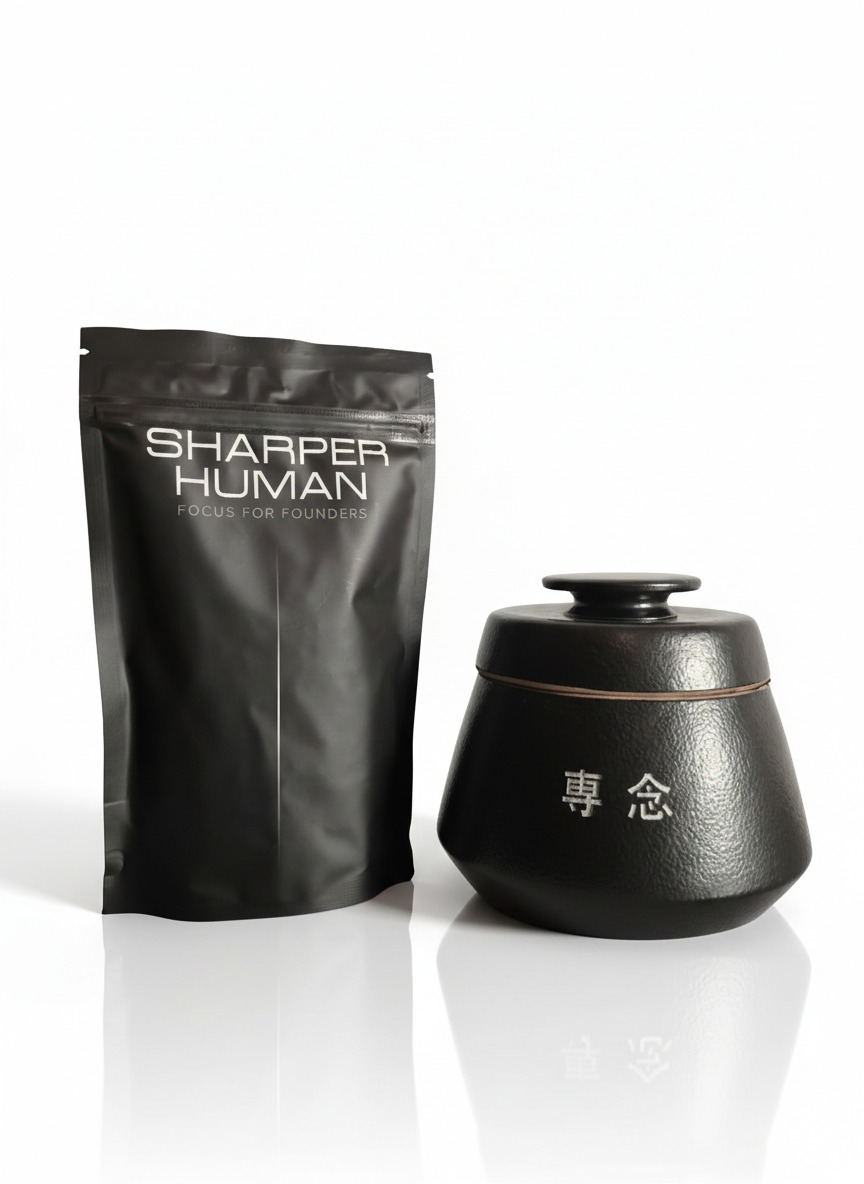
Focus for Founders.
An all-natural brain performance supplement. 20 research-backed ingredients. No caffeine. No stimulants.
Buy on Amazon UKSharper Human is a daytime cognitive-performance formula, so its 1000mg of Lion's Mane is a natural fit: it targets the neural and cognitive systems the product is built around. The more interesting decision is the adaptogen. Sharper Human uses Rhodiola Rosea (150mg of a 5:1 extract) rather than ashwagandha, and the reasoning reflects the comparison above. Rhodiola is the more activating, fatigue-focused adaptogen — studied for mental energy and resistance to tiredness, which suits a morning performance stack — whereas ashwagandha's calming, sleep-leaning profile is better suited to an evening product. Including a sedating adaptogen in a daytime focus formula would work against its purpose. That is the kind of fit-for-purpose choice behind each of the stack's 20 ingredients.
For anyone choosing between the two as standalone supplements, the guidance is straightforward: pick ashwagandha for stress and sleep support, and Lion's Mane for cognition and nerve health — and consider both, at different times of day, if both goals apply. For those who would rather have Lion's Mane working within a complete daytime stack, Sharper Human delivers 1000mg alongside 19 other ingredients, available on Amazon in the UK for around £79 per month, with US availability planned.
References & further reading
- Kongkeaw C, Dilokthornsakul P, Thanarangsarit P, et al. Meta-analysis of randomized controlled trials on cognitive effects of Bacopa monnieri extract. Journal of Ethnopharmacology. 2014;151(1):528–535. View source ↗
- Punja S, Shamseer L, Olson K, Vohra S. Rhodiola rosea for Mental and Physical Fatigue in Nursing Students: A Randomized Controlled Trial. PLoS One. 2014;9(9):e108416. View source ↗
- Docherty S, Doughty FL, Smith EF. The Acute and Chronic Effects of Lion’s Mane Mushroom Supplementation on Cognitive Function, Stress and Mood in Young Adults. Nutrients. 2023;15. View source ↗
- National Institutes of Health, Office of Dietary Supplements. Omega3Fatt\1 \2cids — Fact Sheet for Health Professionals. View source ↗
- Peer-reviewed research on ashwagandha lions mane — PubMed, U.S. National Library of Medicine. View source ↗