
CoQ10 (coenzyme Q10) is a staple of the energy and anti-ageing supplement aisle, and it has a sound mechanistic rationale — it is central to how cells produce energy. But like several popular ingredients, the gap between its theoretical promise and its practical, everyday cognitive benefit is worth understanding honestly. This is a clear-eyed look at what CoQ10 does, who actually benefits, the absorption issues that complicate it, and why Sharper Human supports brain energy through Acetyl-L-Carnitine rather than CoQ10.
Key Takeaways
What CoQ10 Is
CoQ10 is a fat-soluble compound found in virtually every cell, where it plays an essential role in the mitochondrial electron transport chain — the machinery that generates ATP, the body's energy currency. It also functions as an antioxidant, protecting cells from oxidative damage. The body makes its own CoQ10, but levels decline with age, and certain medications, most notably statins, reduce its production as a side effect. This is the core of CoQ10's legitimate use case: it is most relevant for replenishing depleted levels in specific groups — older adults, statin users, and some clinical contexts — rather than as a broad cognitive enhancer for healthy people with normal levels.
What the Evidence Supports
CoQ10 has reasonable evidence in its core areas: supporting energy and reducing statin-associated muscle symptoms in some people, cardiovascular contexts, and as an antioxidant. The cognitive and brain-specific evidence in otherwise healthy people, however, is much thinner. The mechanistic case — that an energy-hungry brain should benefit from better mitochondrial function — is appealing, but it has not translated into strong, consistent human cognitive results for general use. This is a recurring theme with energy-related supplements: a sound mechanism does not automatically produce a noticeable everyday cognitive effect, and honest formulation means distinguishing the two.
The Absorption Problem
There is a further practical complication: CoQ10 is notoriously poorly and variably absorbed. It is fat-soluble, so it is far better taken with a fatty meal, and the reduced form (ubiquinol) is often marketed as more bioavailable than the standard form (ubiquinone), though the picture is debated and ubiquinol products cost more. Bioavailability also varies considerably between individuals and formulations. None of this makes CoQ10 useless — for the groups who genuinely need it, it is worthwhile — but it does mean that simply listing CoQ10 on a label says little about how much actually reaches the cells.
Who Should Actually Consider CoQ10
None of this means CoQ10 is without value — it means its value is targeted rather than universal, and knowing who genuinely benefits is the useful part. The clearest case is people taking statins, since these medications lower the body's own CoQ10 production, and supplementation is often discussed as a way to address statin-associated muscle aches; anyone in that situation should raise it with their doctor. Older adults are another group, given that natural CoQ10 levels decline with age. There are also specific cardiovascular and clinical contexts where CoQ10 has reasonable supporting evidence. For these people, a quality product can be worthwhile — whereas a healthy young omnivore with normal levels is unlikely to notice much from it.
If CoQ10 is the right choice, a few practical points improve the odds of getting a real effect. Because it is poorly and variably absorbed, it should be taken with a meal containing fat; the reduced form, ubiquinol, is often marketed as more bioavailable than standard ubiquinone, though it costs more and the evidence is debated; and typical doses fall in the region of 100–200mg daily. The honest summary is that CoQ10 is a legitimate, targeted supplement for the groups who need it, best taken thoughtfully and with food — but it is not a general cognitive enhancer, and for everyday brain energy in a daily focus stack aimed at a broad, healthy audience, the better-absorbed and more cognitively relevant Acetyl-L-Carnitine is the sounder choice, which is exactly the reasoning behind its inclusion.
Why Sharper Human Uses ALCAR Instead
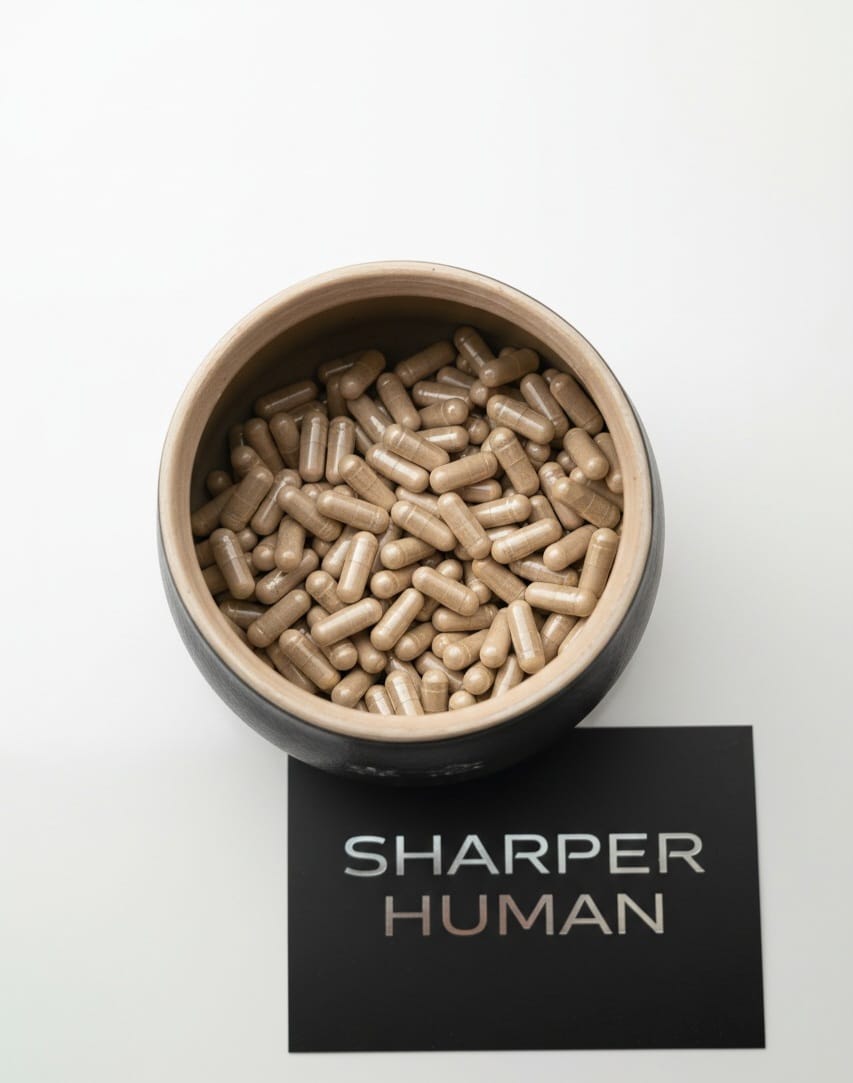
Focus for Founders.
An all-natural brain performance supplement. 20 research-backed ingredients. No caffeine. No stimulants.
Buy on Amazon UKFor the brain-energy role within its formula, Sharper Human uses Acetyl-L-Carnitine (ALCAR) at 500mg rather than CoQ10, and the choice is deliberate. ALCAR supports mitochondrial energy production in the brain with research more directly oriented toward cognition and mental energy, it is generally better absorbed than CoQ10, and it carries a useful bonus: the acetyl group can contribute to acetylcholine synthesis, tying it to the attention and memory systems the rest of the stack supports. In short, for a daytime cognitive formula aimed at a broad, generally healthy audience, ALCAR delivers the brain-energy benefit more reliably and with better cognitive relevance than CoQ10 would. That is the same evidence-led, fit-for-purpose reasoning behind all 20 of the formula's ingredients.
The honest bottom line: CoQ10 is a worthwhile supplement for the people who genuinely need it — older adults, statin users and certain clinical situations — and those individuals may well benefit from a quality, well-absorbed product taken with food. But as a general cognitive enhancer it is overrated, and for brain energy in a daily focus stack aimed at a broad and generally healthy audience, Acetyl-L-Carnitine is the better-evidenced and more practical choice. Sharper Human is available on Amazon in the UK for around £79 per month, with US availability planned.
References & further reading
- Peer-reviewed research on coq10 brain energy — PubMed, U.S. National Library of Medicine. View source ↗
- Suliman NA, Mat Taib CN, Mohd Moklas MA, et al. Establishing Natural Nootropics: Recent Molecular Enhancement Influenced by Natural Nootropic. Evidence-Based Complementary and Alternative Medicine. 2016. View source ↗