
Phosphatidylcholine and phosphatidylserine sound almost identical and are both phospholipids found in cell membranes, so they are easily confused — but they play different roles, and their cognitive evidence differs meaningfully. Understanding the distinction clarifies why one features prominently in focus formulas while the other is handled differently. This is an honest comparison of phosphatidylcholine versus phosphatidylserine: what each is, how they differ in role and cognitive evidence, and why Sharper Human includes phosphatidylserine. This article is informational and not medical advice.
Key Takeaways
Two Similar-Sounding Phospholipids
Phosphatidylcholine and phosphatidylserine belong to the same family — phospholipids, the fat molecules that make up cell membranes, including those of brain cells. Their similar names and shared membrane role make them easy to confuse, but they are distinct compounds with different abundance, functions and evidence profiles. Both are genuinely relevant to the brain, since healthy neuronal membranes are essential for cognition, but the nature and strength of their cognitive relevance differ. Understanding the distinction is useful both for choosing supplements and for understanding how a formula handles the membrane and choline aspects of brain health. The two are sometimes both present in foods and supplements, and phosphatidylcholine is actually a component of lecithin, a common food additive and supplement — which hints at its more general, structural nature compared with phosphatidylserine's more specific cognitive profile.
Phosphatidylcholine: Structure and Choline
Phosphatidylcholine is one of the most abundant phospholipids in cell membranes and in the body, serving as a major structural building block of membranes throughout. It is also a source of choline — the nutrient used to make acetylcholine and to support membranes — and is a primary form in which choline is stored and transported in the body. Phosphatidylcholine is found in foods (eggs, soy and others) and in lecithin supplements. Its roles are therefore largely structural and choline-related: maintaining membrane integrity and contributing to the body's choline supply. However, as a direct cognitive-enhancement ingredient, phosphatidylcholine has relatively limited specific evidence — it is more a foundational structural and choline-supplying compound than a targeted memory enhancer. For supplying choline specifically for cognition, other forms (like citicoline or Alpha-GPC) are typically more efficient and better-evidenced choices.
Phosphatidylserine: the Memory Phospholipid
Phosphatidylserine, while less abundant than phosphatidylcholine, is functionally important and concentrated in brain cell membranes, where it plays specific roles in cell signalling and membrane function. Crucially, it has stronger and more direct cognitive evidence: phosphatidylserine is studied for supporting memory and cognitive function, with particular interest in age-related memory support, making it one of the better-evidenced phospholipid ingredients for cognition specifically. This is the key difference — where phosphatidylcholine is a general structural and choline compound, phosphatidylserine has more targeted, memory-oriented evidence. Sharper Human includes phosphatidylserine at 301mg, and the dedicated phosphatidylserine guide covers it in depth. For the memory and cognitive-membrane angle, phosphatidylserine is the more relevant and better-evidenced of the two phospholipids.
Head to Head: Different Roles
Comparing them directly: phosphatidylcholine is the more abundant, general structural phospholipid and a choline source, with limited direct cognitive-enhancement evidence; phosphatidylserine is less abundant but has more specific, stronger evidence for supporting memory and cognition. They are not really competitors so much as compounds with different roles — phosphatidylcholine more foundational and choline-related, phosphatidylserine more targeted to memory. For someone specifically interested in cognitive and memory support, phosphatidylserine is the more relevant choice based on the evidence. For choline supply specifically, neither is the most efficient option — dedicated choline sources like citicoline serve that purpose better, as the comparison of citicoline vs phosphatidylserine explores. So the sensible formulation approach is to use phosphatidylserine for its memory evidence and a dedicated choline source for choline, rather than relying on phosphatidylcholine for either.
How a Formula Covers Both Needs
This comparison points to how a well-designed formula efficiently covers the relevant needs. Rather than including phosphatidylcholine (a general structural compound with limited direct cognitive evidence and inefficient choline delivery), a thoughtful formula can include phosphatidylserine for its targeted memory evidence and supply choline through a dedicated, well-evidenced source like citicoline. This covers both the memory-phospholipid angle and the choline angle with the most appropriate ingredient for each, rather than relying on a single general compound for both. It reflects a broader formulation principle of using the best-suited ingredient for each specific role. The combination of phosphatidylserine plus citicoline, as the guide to the best nootropics for memory covers, addresses memory and choline more effectively than phosphatidylcholine would for either purpose — which is exactly the approach a focus formula sensibly takes.
Why Sharper Human Includes Phosphatidylserine
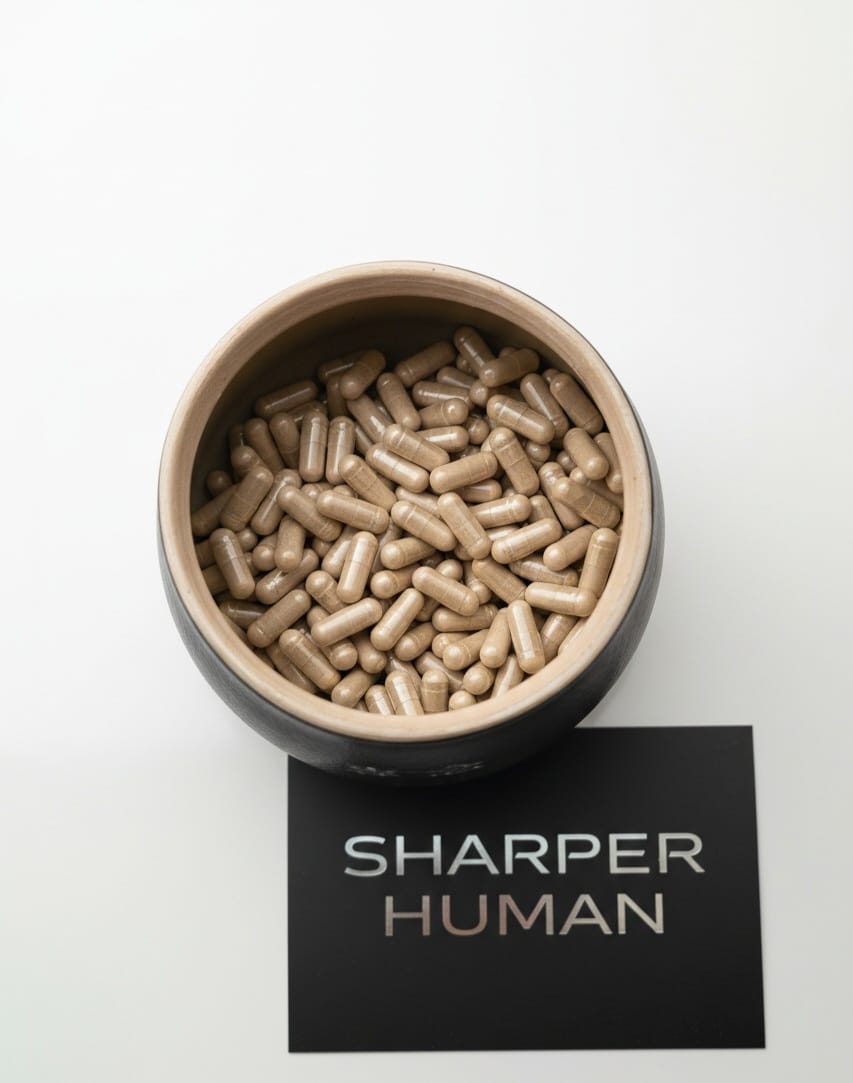
Focus for Founders.
An all-natural brain performance supplement. 20 research-backed ingredients. No caffeine. No stimulants.
Buy on Amazon UKSharper Human includes phosphatidylserine (301mg) rather than phosphatidylcholine, and the reasoning follows from the comparison. Phosphatidylserine has the stronger, more direct evidence for supporting memory and cognition, making it the better-suited phospholipid for a focus formula's goals, whereas phosphatidylcholine is a more general structural compound with limited direct cognitive evidence. For the choline that phosphatidylcholine would inefficiently supply, the formula uses a dedicated, well-evidenced source — Citicoline (300mg) — covering the choline need more effectively. This use of the best-suited ingredient for each role — phosphatidylserine for memory, citicoline for choline — is the fit-for-purpose logic behind all 20 ingredients, detailed in the ingredients and dosages guide. The result covers both the memory-phospholipid and choline needs efficiently and on the evidence.
The honest bottom line: phosphatidylcholine is a general structural phospholipid and choline source with limited direct cognitive evidence, while phosphatidylserine has stronger, more direct memory evidence — so Sharper Human includes phosphatidylserine (301mg) for memory and supplies choline through Citicoline, the best-suited ingredient for each role. Sharper Human is available on Amazon in the UK, with US availability planned.
References & further reading
- Nakazaki E, Mah E, Sanoshy K, et al. Citicoline and Memory Function in Healthy Older Adults: A Randomized, Double-Blind, Placebo-Controlled Clinical Trial. The Journal of Nutrition. 2021. doi:10.1093/jn/nxab119. View source ↗
- Peer-reviewed research on phosphatidylcholine phosphatidylserine — PubMed, U.S. National Library of Medicine. View source ↗