
PQQ (pyrroloquinoline quinone) is a trendy ingredient in the "mitochondrial health" and longevity space, often paired with CoQ10 and promoted for brain energy on the strength of an exciting-sounding mechanism. It is a genuinely interesting compound — but, as with several mechanism-led supplements, the gap between its theoretical appeal and its proven everyday cognitive benefit in humans is worth examining honestly. This is a clear-eyed look at PQQ, the evidence, the practical drawbacks, and why Sharper Human supports brain energy through Acetyl-L-Carnitine instead.
Key Takeaways
What PQQ Is
PQQ is a small quinone compound found in trace amounts in various foods and produced by certain bacteria. Its claim to fame is its proposed effect on mitochondria, the energy-producing organelles inside cells: beyond supporting existing mitochondrial function and acting as an antioxidant, PQQ is studied for the intriguing possibility of supporting mitochondrial biogenesis — the generation of new mitochondria. Since the brain is an extremely energy-hungry organ packed with mitochondria, this mechanism is the basis for PQQ's marketing as a brain-energy and cognitive ingredient. It is often sold alongside CoQ10, on the logic that the two support mitochondrial energy in complementary ways. The mechanism is genuinely interesting — the question, as ever, is whether it translates into noticeable real-world benefit.
Where the Evidence Stands
PQQ's evidence is best described as early and promising rather than established. There is some human research, including small studies touching on energy, fatigue, sleep and aspects of cognition, and the mitochondrial-biogenesis mechanism has support in preclinical work. But the body of robust human evidence specifically for cognitive enhancement in healthy people is limited, the studies tend to be small, and firm conclusions are premature. This places PQQ in a familiar category: a compound with an appealing, science-forward mechanism and encouraging early signals, but not yet the kind of solid human evidence that would justify treating it as a proven cognitive enhancer. Honest framing means acknowledging both the promise and the immaturity of the evidence.
The Cost and Practical Questions
Beyond the evidence, a couple of practical considerations weigh on PQQ. It is a relatively expensive ingredient, which matters for a supplement meant to deliver value — paying a premium for a compound whose cognitive benefit is still unproven is a questionable trade. Effective doses in research are small (often in the region of 10–20mg), and while PQQ appears reasonably safe in those amounts, its long-term safety profile in healthy people taking it for enhancement is not extensively characterised, simply because it is a newer ingredient. None of this makes PQQ a bad compound — it makes it an early-stage, premium one, which is a different proposition from a well-established, well-priced, well-evidenced ingredient.
PQQ vs the Established Brain-Energy Options
It helps to compare PQQ with the brain-energy ingredients that have more track record. CoQ10 is most relevant for those with depleted levels and has its own absorption issues. Acetyl-L-Carnitine, by contrast, has research oriented more directly toward brain energy and cognition, is well absorbed, and carries a useful bonus — its acetyl group can contribute to acetylcholine synthesis, tying it to the attention and memory systems. Against that, PQQ is the newest and least-proven of the group for everyday cognitive benefit, and the most expensive. For a formula choosing where to spend its capsule space and the buyer's money, the established, well-absorbed, cognitively-relevant option is the sounder bet. The deep-dives on CoQ10 and Acetyl-L-Carnitine cover the comparison further.
The Trendy-Ingredient Trap
PQQ is a useful illustration of a wider trap in supplement shopping: the appeal of the newest, most science-forward-sounding ingredient. Compounds like PQQ arrive with an exciting mechanism (here, mitochondrial biogenesis), impressive-sounding language, and a premium price, and it is tempting to assume that newer and more cutting-edge means better. But the established ingredients earned their place precisely by accumulating the human evidence and safety track record that newer compounds have not yet built. A sensible buyer treats novelty and mechanistic excitement as reasons for interest, not reasons to pay up, and waits for the human evidence to catch up with the marketing. Applied to brain energy, that means favouring a well-studied, well-priced, well-absorbed option like Acetyl-L-Carnitine over a trendy, expensive, early-stage one like PQQ — at least until the evidence for the newcomer matures. This is the same discipline that runs through how Sharper Human selects every ingredient: follow the human evidence and value, not the hype cycle, and let other products chase the latest fashionable compound.
Why Sharper Human Uses ALCAR Instead
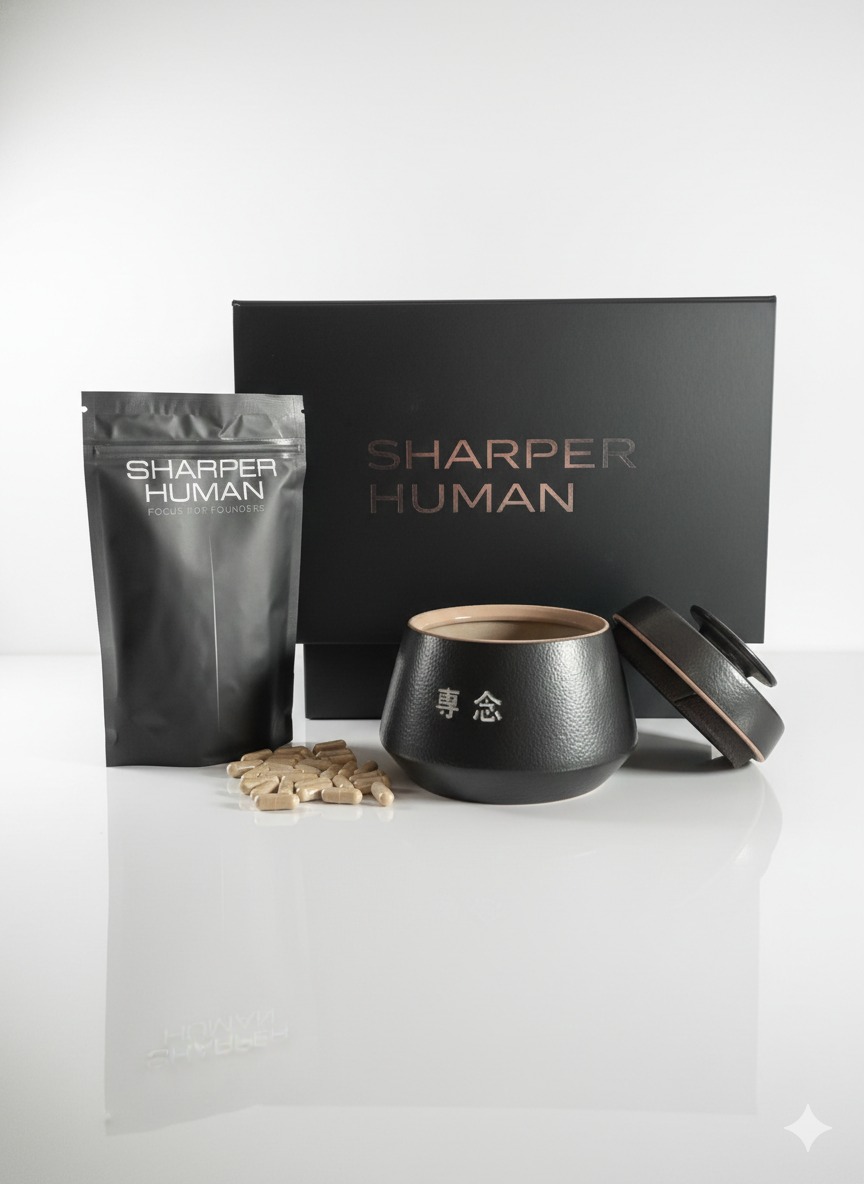
Focus for Founders.
An all-natural brain performance supplement. 20 research-backed ingredients. No caffeine. No stimulants.
Buy on Amazon UKFor the brain-energy role within its formula, Sharper Human uses Acetyl-L-Carnitine at 500mg rather than PQQ, and the choice is deliberate and evidence-led. ALCAR supports mitochondrial energy production in the brain with research more directly relevant to cognition, is well absorbed, and adds a cholinergic benefit that complements the rest of the stack — whereas PQQ, for all its mechanistic appeal, has thinner human cognitive evidence, a higher cost, and a less-established profile. Spending a capsule slot and the buyer's money on the better-evidenced, better-value option is exactly the principle behind all 20 of the formula's ingredients. For antioxidant support within a cognitive remit, the formula draws on ingredients like Bilberry rather than reaching for every trendy antioxidant compound.
The honest bottom line: PQQ is a genuinely interesting, mechanism-rich compound with promising early signals for mitochondrial and brain energy, and enthusiasts may wish to follow the research — but its human cognitive evidence is still preliminary and it is expensive, so for brain energy in a daily focus stack, the established Acetyl-L-Carnitine is the sounder choice, which is why Sharper Human uses it. Sharper Human is available on Amazon in the UK for around £79 per month, with US availability planned.
References & further reading
- Peer-reviewed research on pqq brain energy — PubMed, U.S. National Library of Medicine. View source ↗
- Suliman NA, Mat Taib CN, Mohd Moklas MA, et al. Establishing Natural Nootropics: Recent Molecular Enhancement Influenced by Natural Nootropic. Evidence-Based Complementary and Alternative Medicine. 2016. View source ↗