Saffron — the precious red spice — has become an interesting ingredient in the supplement world, with a growing body of research for mood and some signals for cognition. Unlike many ingredients covered in "why it's not in the formula" pieces, saffron's evidence is genuinely promising rather than weak. The reasons it sits outside a focus formula are more about fit, cost and scope than a lack of merit. This is an honest look at what saffron does, where its evidence stands, and why Sharper Human prioritises focus-oriented ingredients instead. This article is informational and not medical advice, and saffron is not a treatment for any condition.
Key Takeaways
What Saffron Is
Saffron is the dried stigma of the Crocus sativus flower, famous as the world's most expensive spice by weight — it takes thousands of hand-picked flowers to produce a small amount, which is central to one of the practical points below. Beyond the kitchen, saffron contains bioactive compounds, notably crocin, crocetin and safranal, which are thought to have antioxidant and neuro-supportive properties, and these have made it a subject of genuine scientific interest for mood and, increasingly, cognition. So while many people know saffron only as a culinary luxury, it has a legitimate emerging profile as a studied botanical, which sets it apart from ingredients included in supplements on the basis of tradition or hype alone.
The Mood Evidence Is Genuinely Promising
Saffron's strongest research is in the area of mood, and it is fair to say the evidence is among the more promising for any botanical. A number of human studies have examined saffron extract in relation to mood and emotional wellbeing, with several producing encouraging results, and saffron is one of the more credible plant ingredients in this space. That said, two honest caveats matter enormously. First, "promising" is not the same as "proven beyond doubt", and more research continues. Second, and crucially, this does not make saffron a treatment for clinical depression or any mental-health condition — depression is a serious medical matter that requires professional assessment and care, not self-management with a supplement. Saffron's mood research is best understood as supporting general mood and wellbeing, with clinical conditions firmly in a doctor's domain.
The Cognitive and Other Angles
Beyond mood, saffron has some emerging interest for cognition and other areas. Its antioxidant compounds have been explored in relation to cognitive function, including some research in the context of age-related cognitive concerns, and saffron has also been studied for eye health (its compounds may benefit the retina). These are genuinely interesting avenues, but the cognitive and eye evidence is earlier and thinner than the mood evidence, so it should be framed as promising and developing rather than established. The overall picture is of a botanical with a real and growing scientific profile across several areas — most strongly mood — which is more than can be said for many supplement ingredients, even if no single use is yet rock-solid.
The Cost and Fit Questions
So why would a well-formulated focus product leave out an ingredient with such promising evidence? Two practical reasons. First, fit: saffron's strongest evidence is for mood rather than focus and attention specifically, and a focus-and-brain-health formula sensibly prioritises ingredients whose primary evidence is in focus, memory and cognition — saffron's centre of gravity sits slightly outside that core purpose. Second, cost: saffron is extraordinarily expensive, and including a meaningful, well-dosed amount of a standardised saffron extract would consume a disproportionate share of a formula's ingredient budget — budget that arguably delivers more cognitive value spent on focus-oriented actives. This is a genuine formulation trade-off rather than a dismissal of saffron, which remains a worthwhile ingredient for those whose primary goal is mood support.
Where Saffron Might Fit Instead
For someone whose main interest is mood rather than focus, saffron is a reasonable ingredient to consider on its own, ideally as a standardised extract at a researched dose, and ideally distinct from the question of cognitive enhancement. It sits in a different category from focus actives — closer to mood-and-wellbeing support — and the guide to herbs and adaptogens places it among the botanicals worth knowing. For mood specifically, the broader and more powerful levers remain exercise, sleep, social connection and, where mood is significantly low, professional support — saffron being a possible supportive addition rather than a solution. And the deep-dive on 5-HTP covers another mood-oriented compound (with its own important safety caveats), illustrating that mood support is a distinct goal from the focus that a cognitive formula targets.
Why Sharper Human Prioritises Focus Ingredients
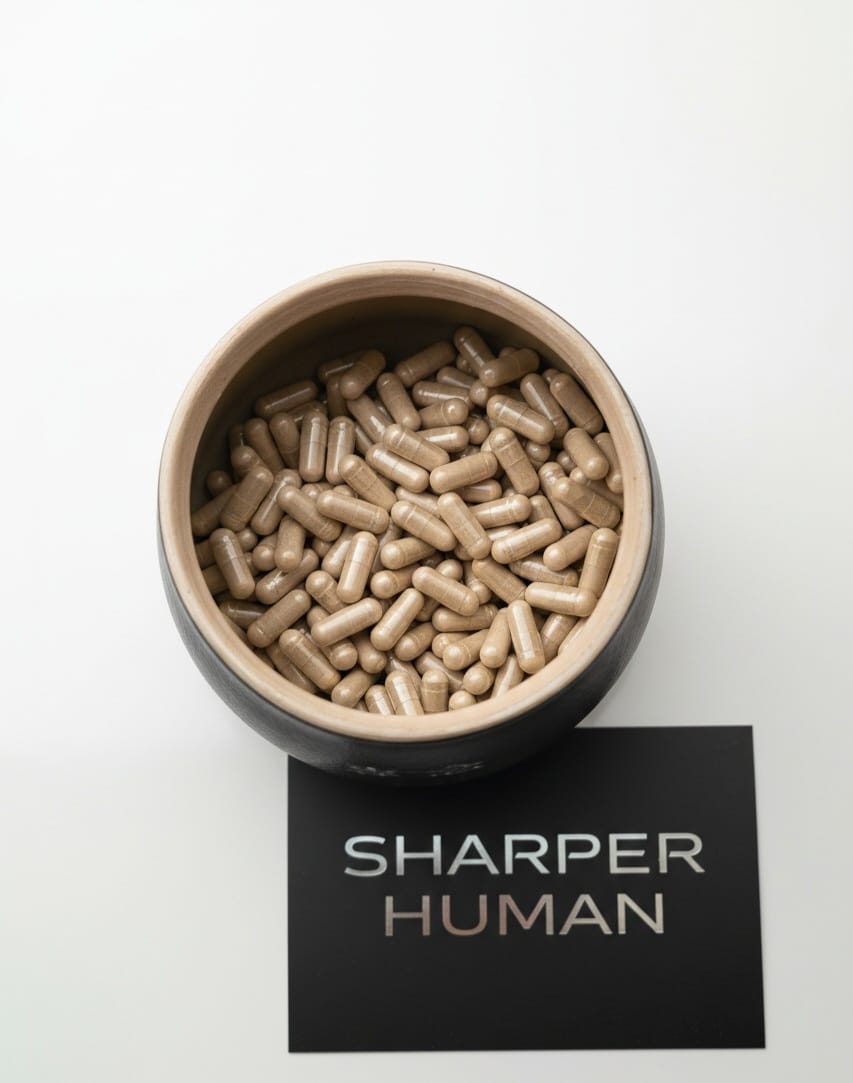
Focus for Founders.
An all-natural brain performance supplement. 20 research-backed ingredients. No caffeine. No stimulants.
Buy on Amazon UKSharper Human does not include saffron, and the reasoning is one of focus and value rather than any dismissal of the ingredient. As a focus-and-brain-health formula, Sharper Human prioritises ingredients whose strongest evidence is in attention, memory and cognition — Citicoline, Bacopa, L-Tyrosine, Lion's Mane, Rhodiola and the rest — and it spends its capsule space and ingredient budget on those most-relevant, well-evidenced actives rather than on an expensive, mood-oriented botanical that sits outside its core purpose. This is the same fit-for-purpose, value-conscious logic behind all 20 ingredients, detailed in the ingredients and dosages guide. Saffron is a genuinely interesting ingredient — just one whose strengths and cost place it outside a focus stack. The complete nootropics guide covers the focus-oriented ingredients the formula prioritises.
The honest bottom line: saffron is a botanical with genuinely promising mood evidence and emerging cognitive interest, but its mood-leaning focus and high cost place it outside a focus formula — so Sharper Human prioritises well-evidenced focus ingredients instead. Saffron is not a treatment for depression, which needs professional care. Sharper Human is available on Amazon in the UK, with US availability planned.
References & further reading
- Nakazaki E, Mah E, Sanoshy K, et al. Citicoline and Memory Function in Healthy Older Adults: A Randomized, Double-Blind, Placebo-Controlled Clinical Trial. The Journal of Nutrition. 2021. doi:10.1093/jn/nxab119. View source ↗
- Kongkeaw C, Dilokthornsakul P, Thanarangsarit P, et al. Meta-analysis of randomized controlled trials on cognitive effects of Bacopa monnieri extract. Journal of Ethnopharmacology. 2014;151(1):528–535. View source ↗
- Punja S, Shamseer L, Olson K, Vohra S. Rhodiola rosea for Mental and Physical Fatigue in Nursing Students: A Randomized Controlled Trial. PLoS One. 2014;9(9):e108416. View source ↗
- Peer-reviewed research on saffron mood cognition — PubMed, U.S. National Library of Medicine. View source ↗