Decision fatigue is the measurable deterioration in decision quality that occurs after making many decisions in succession. It's not a motivational problem or a character flaw — it's a neurochemical reality with specific physiological mechanisms. For entrepreneurs, executives, traders, and professionals who make hundreds of decisions daily, understanding and addressing decision fatigue is a direct performance and financial concern.
Key Takeaways
The Neuroscience of Decision Fatigue
Decision fatigue operates through three converging mechanisms, each with specific supplementation implications.
Dopamine depletion. Every decision that requires evaluating options, weighing trade-offs, or resisting an easier default consumes dopamine. Dopamine drives the "effortful evaluation" pathway in the prefrontal cortex — the willingness to think carefully rather than react automatically. As dopamine levels decline through the day, the brain progressively favours the path of least resistance: accepting defaults, postponing decisions, or making impulsive choices that feel decisive but lack analytical foundation. Research from Leiden University demonstrated that L-Tyrosine — the amino acid precursor to dopamine — maintains cognitive performance under conditions that would otherwise produce measurable decline.
Prefrontal cortex fatigue. The prefrontal cortex is the brain region responsible for executive function: weighing options, considering consequences, overriding impulses, and maintaining goal-directed behaviour. It's also one of the most metabolically demanding brain regions — consuming disproportionate energy relative to its size. Sustained decision-making progressively fatigues prefrontal circuits, reducing the quality of judgment even when the individual feels subjectively capable of continuing. ALCAR supports mitochondrial energy production that the prefrontal cortex disproportionately depends on. B-vitamins serve as essential cofactors for the energy metabolism enzymes that ATP production requires.
Cortisol accumulation. Decision-making under responsibility — the kind business owners, executives, and traders engage in — is inherently stressful. Each consequential decision triggers a cortisol micro-dose. Accumulated across hundreds of daily decisions, this creates progressive cortisol elevation that directly impairs the prefrontal cortex function that decision quality depends on. Research published in Psychoneuroendocrinology has documented that elevated cortisol reduces working memory capacity, slows processing speed, and impairs cognitive flexibility — all components of sound judgment. Rhodiola Rosea's HPA axis modulation helps prevent this progressive cortisol accumulation from degrading decision quality through the day.
Best Supplements for Decision Fatigue
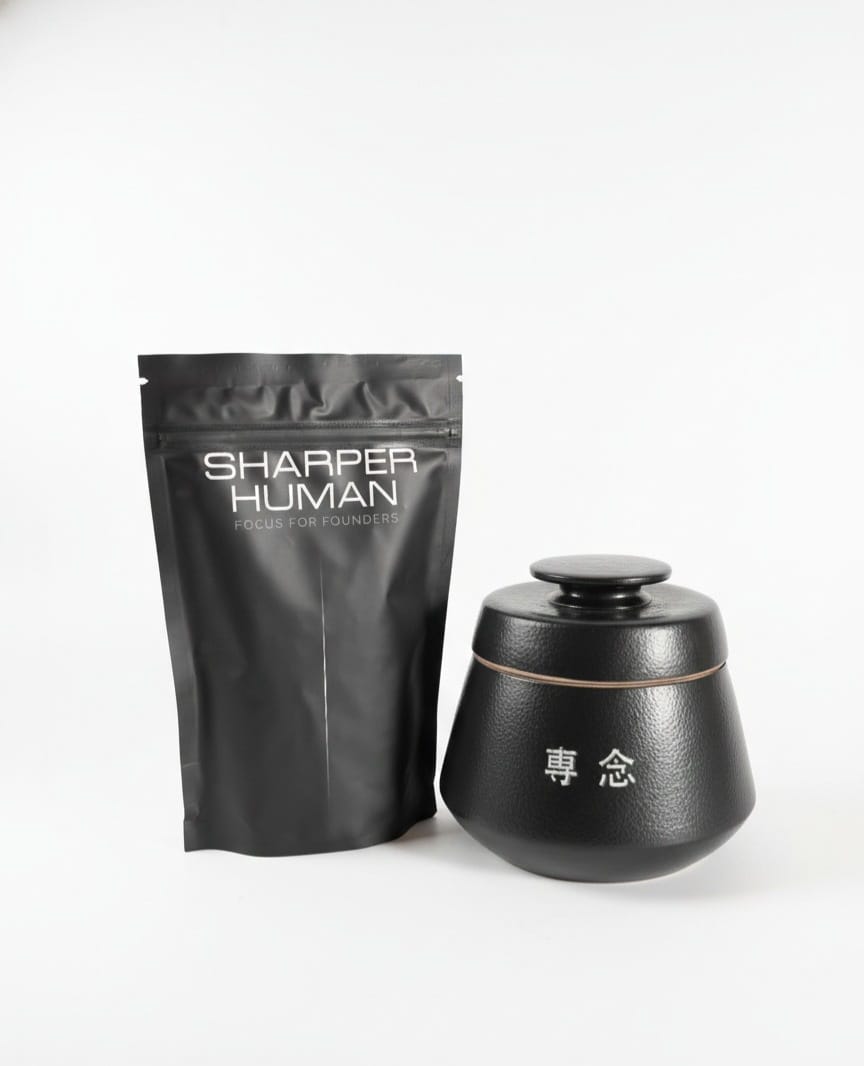
Focus for Founders.
An all-natural brain performance supplement. 20 research-backed ingredients. No caffeine. No stimulants.
Buy on Amazon UKSharper Human addresses all three decision fatigue mechanisms through specific compounds at clinical dosages. L-Tyrosine (350mg) maintains the dopamine supply that effortful evaluation depends on — preventing the progressive shift from careful analysis to impulsive default-selection. Citicoline (300mg) supports the acetylcholine system that sustained attention and working memory require for holding multiple decision factors in mind simultaneously. Rhodiola Rosea (150mg 5:1) modulates the HPA axis to prevent stress-accumulated cortisol from degrading prefrontal function. ALCAR (500mg), Taurine (500mg), and the complete B-vitamin complex support the sustained brain energy metabolism that the prefrontal cortex disproportionately demands.
The zero-stimulant approach is specifically relevant for decision fatigue. Caffeine can mask the subjective experience of fatigue — making you feel alert while the underlying neurochemical depletion continues unchecked. This is dangerous for decision-makers because it creates false confidence: you feel capable of making good decisions while the neurochemistry that actually produces good decisions has degraded. Stimulant-free nootropics address the underlying mechanisms rather than masking symptoms.
Structural Strategies Alongside Supplementation
Supplements support the neurochemistry, but decision architecture matters equally. Research-backed strategies include front-loading important decisions to morning hours when neurochemical reserves are highest, batching similar decisions together (reducing switching costs), establishing standard operating procedures for routine decisions (eliminating the evaluation step entirely), and scheduling genuine rest breaks between decision-intensive work sessions. The NHS wellbeing guidance supports the broader principle that cognitive performance depends on adequate rest, not just sustained effort.
Decision Architecture: Structural Strategies Alongside Supplementation
Supplements support the neurochemistry, but decision architecture — the structural design of how and when you make decisions — is equally important for managing decision fatigue. Research-backed strategies include front-loading important decisions to morning hours when neurochemical reserves are highest (take Sharper Human with breakfast so peak bioavailability aligns with peak decision quality), batching similar decisions together to reduce switching costs, establishing standard operating procedures for routine decisions (eliminating the evaluation step entirely for recurring choices), and scheduling genuine rest breaks between decision-intensive sessions.
Steve Jobs famously wore the same outfit daily to eliminate one category of decisions entirely. While this specific approach is extreme, the underlying principle is sound: every decision you can systematise, automate, or eliminate preserves neurochemical capacity for the decisions that actually matter. For entrepreneurs and executives making hundreds of consequential decisions daily, the combination of neurochemical support (L-Tyrosine, Citicoline, Rhodiola, B-vitamins) and structural decision reduction creates a compounding advantage that neither approach achieves alone.
The NHS wellbeing guidance supports the broader principle: cognitive performance depends on adequate rest, physical activity, and stress management alongside any supplementation. Decision fatigue is ultimately a resource management problem — and the most effective management combines increasing the resource supply (supplementation) with reducing the resource demand (decision architecture).
Protecting Your Most Important Decisions
Beyond supporting the brain and using structural strategies, one of the most effective responses to decision fatigue is to deliberately protect your most important decisions by timing them well. Decision quality tends to decline through the day as the cumulative load of choices mounts, which is why scheduling genuinely important, high-stakes decisions for earlier in the day — when mental resources are freshest — rather than late afternoon, when fatigue has set in, can meaningfully improve them. Conversely, recognising when you are depleted and deferring a major decision until you are rested, rather than forcing it, is a simple but powerful safeguard against the poor judgement that decision fatigue produces.
Two practical supports reinforce this. Maintaining stable energy through proper meals helps, since the brain's decision-making is metabolically demanding and large blood-sugar swings can worsen fatigue and impulsivity — steady nutrition avoids the crashes that erode judgement. And building in genuine breaks to let the mind recover between demanding decisions preserves capacity across the day. The overarching principle is to treat your decision-making capacity as a finite, protectable resource: spend it on what matters, conserve it by reducing trivial choices, and avoid making consequential calls when depleted. Sharper Human supports the underlying cognition and stress resilience that decision-making draws on — through ingredients like L-Tyrosine, which supports performance under mental load, and a full B-complex — as a complement to these structural habits of protecting, timing and conserving your most important decisions.
References & further reading
- Nakazaki E, Mah E, Sanoshy K, et al. Citicoline and Memory Function in Healthy Older Adults: A Randomized, Double-Blind, Placebo-Controlled Clinical Trial. The Journal of Nutrition. 2021. doi:10.1093/jn/nxab119. View source ↗
- Punja S, Shamseer L, Olson K, Vohra S. Rhodiola rosea for Mental and Physical Fatigue in Nursing Students: A Randomized Controlled Trial. PLoS One. 2014;9(9):e108416. View source ↗
- Peer-reviewed research on decision fatigue — PubMed, U.S. National Library of Medicine. View source ↗