Dopamine is one of the most talked-about and most misunderstood brain chemicals. Popularly framed as the "pleasure chemical", it is better understood as the neurotransmitter of motivation and drive — the chemistry behind wanting, pursuing and pushing toward goals. Understanding dopamine clarifies what motivation actually is and how it can be supported. This is an honest, accessible explainer on dopamine: what it really does, how it works, what supports it, and how Sharper Human supports the dopamine system. It pairs with the companion explainer on acetylcholine. This article is informational and not medical advice.
Key Takeaways
What Dopamine Really Is
Dopamine is a neurotransmitter — a chemical messenger in the brain — that plays a central role in motivation, drive, reward and goal-directed behaviour, as well as contributing to focus, movement and learning. It is one of the brain's key "catecholamine" neurotransmitters (alongside noradrenaline), and its function in the brain's reward and motivation circuitry makes it fundamental to why we pursue goals, feel driven, and engage with tasks. Dopamine is produced in the brain from the amino acid tyrosine (via an intermediate), which is why the raw materials for its production matter. Understanding dopamine is genuinely illuminating, because motivation — something often treated as a mysterious or purely willpower-based quality — has a real neurochemical basis, with dopamine at its centre. But that understanding requires correcting a widespread misconception about what dopamine actually does, which is where much popular framing goes wrong.
The "Pleasure Chemical" Misconception
Dopamine is popularly called the "pleasure chemical", but this is an oversimplification that misses its real role. More accurately, dopamine is the neurotransmitter of motivation, anticipation and "wanting" — the drive to pursue a reward — rather than the pleasure of actually consuming or experiencing it (other systems are more involved in the pleasure itself). In other words, dopamine powers the "go and get it" — the motivation to pursue a goal and the anticipation of reward — more than the enjoyment at the end. This distinction matters because it reframes dopamine as fundamentally about drive and motivation: it is what gets you to start a task, pursue a goal, and push through effort, driven by the anticipation of reward. This is why dopamine is so relevant to focus and productivity — the motivation to engage with and persist at a task is dopamine-driven. Grasping that dopamine is about "wanting and pursuing" rather than "liking" is the key to understanding motivation correctly.
Dopamine, Motivation and Focus
Dopamine's role in motivation connects directly to focus and productivity. The drive to start a task, sustain effort, resist distraction, and persist toward a goal is underpinned by dopamine and the brain's motivation circuitry — which is why low motivation, difficulty initiating tasks, and procrastination can relate to dopamine function, and why feeling driven and engaged reflects healthy dopamine signalling. Dopamine also contributes more directly to focus and attention, working alongside noradrenaline (which it is a precursor to). So the motivation to engage with work, and the focus to sustain it, both draw on the dopamine system. This makes dopamine central to the cognitive qualities people seek to support — not just focus in the narrow sense, but the drive and motivation that determine whether focus is applied at all. Understanding this clarifies why supporting the dopamine system is relevant to productivity and goal-pursuit, as the guide to supporting dopamine covers.
What Supports Healthy Dopamine Function
Healthy dopamine function is supported by several lifestyle factors and by ensuring the raw materials for its production. On lifestyle: good sleep supports dopamine signalling (sleep deprivation impairs it), exercise supports the dopamine system, sunlight and morning light exposure are beneficial, and the structure of goals matters — achievable, rewarding goals and a sense of progress support motivation, whereas constant frustration or over-reliance on quick artificial hits (like endless digital stimulation) can dysregulate the reward system. On raw materials: dopamine is made from the amino acid tyrosine, so adequate tyrosine provides the building block for its production, which is the rationale for L-Tyrosine supplementation supporting dopamine, especially under stress and demand when production is taxed, as the L-Tyrosine guide covers. Supporting dopamine is therefore largely about healthy lifestyle plus ensuring the precursors are available — not about artificially spiking it.
Dopamine in the Bigger Picture
It is worth placing dopamine within the broader picture of brain chemistry, since cognition and motivation involve multiple neurotransmitters working together. Dopamine drives motivation and contributes to focus; acetylcholine is central to attention and memory (as the companion guide to acetylcholine and focus covers); noradrenaline (made from dopamine) supports alertness and focus under stress; serotonin influences mood; and others play their parts. A well-rounded approach to supporting cognition therefore considers more than one system — which is why a thoughtful formula supports several neurotransmitter systems rather than fixating on dopamine alone. Dopamine is a crucial piece, given its role in the motivation and drive that underpin productivity, but it works in concert with the other systems. Understanding that different neurotransmitters govern different aspects of cognition explains why supporting cognition well means supporting multiple systems, with dopamine being one key part of that broader picture.
How Sharper Human Supports the Dopamine System
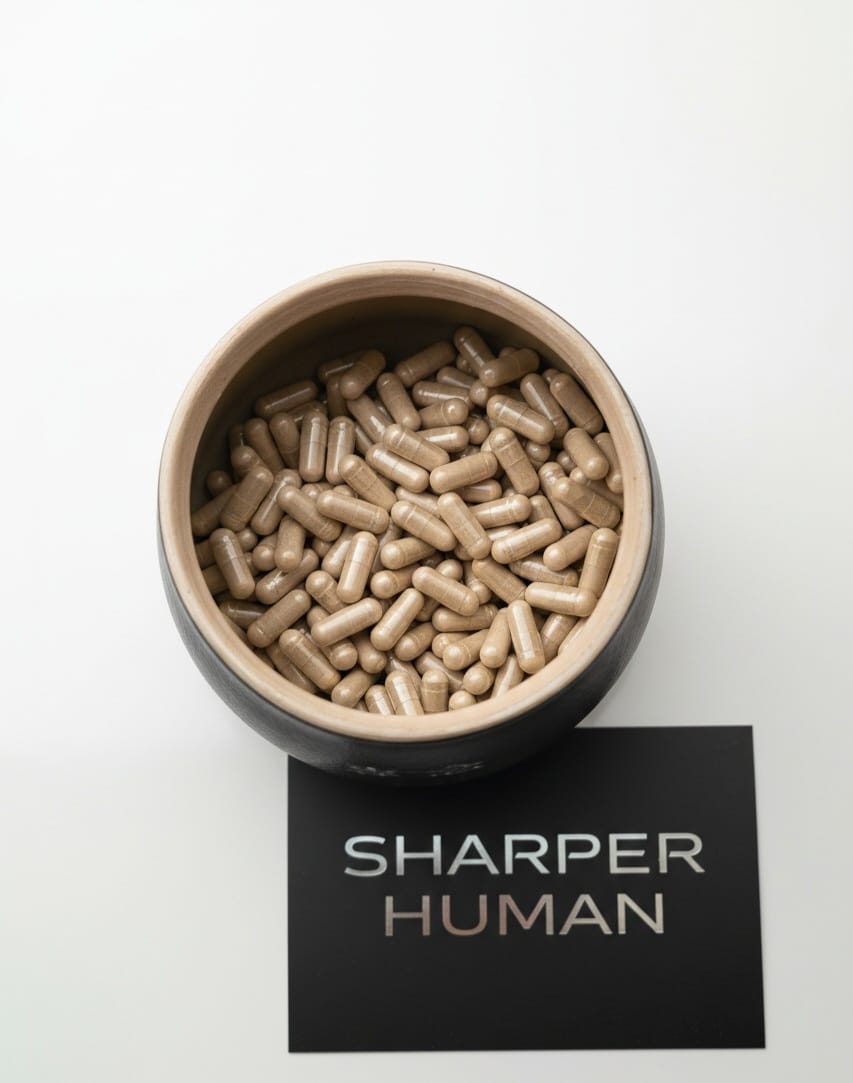
Focus for Founders.
An all-natural brain performance supplement. 20 research-backed ingredients. No caffeine. No stimulants.
Buy on Amazon UKSharper Human supports the dopamine system primarily through L-Tyrosine (350mg) — the amino acid the body uses as the raw material to produce dopamine (and, downstream, noradrenaline) — supporting the precursor supply for these motivation-and-focus neurotransmitters, which is especially relevant under stress and high demand when production is taxed. This is complemented by the broader formula supporting other systems: Citicoline for the acetylcholine (attention) system, Rhodiola for stress resilience (which protects dopamine-related function under pressure), and the full B-complex providing cofactors involved in neurotransmitter production. By supplying the building block for dopamine and supporting the surrounding systems, the formula supports the motivation and drive that underpin focus and productivity. This support for the dopamine system, alongside acetylcholine and others, reflects the multi-system, evidence-led logic behind all 20 ingredients, detailed in the ingredients and dosages guide.
The honest bottom line: dopamine is the neurotransmitter of motivation and drive — the chemistry of "wanting and pursuing", not simply pleasure — and it underpins the drive and focus behind productivity. It is supported by healthy lifestyle and by ensuring its raw material, which is how Sharper Human supports it: through L-Tyrosine (350mg), the precursor for dopamine. Sharper Human is available on Amazon in the UK, with US availability planned.
References & further reading
- Nakazaki E, Mah E, Sanoshy K, et al. Citicoline and Memory Function in Healthy Older Adults: A Randomized, Double-Blind, Placebo-Controlled Clinical Trial. The Journal of Nutrition. 2021. doi:10.1093/jn/nxab119. View source ↗
- Punja S, Shamseer L, Olson K, Vohra S. Rhodiola rosea for Mental and Physical Fatigue in Nursing Students: A Randomized Controlled Trial. PLoS One. 2014;9(9):e108416. View source ↗
- Peer-reviewed research on dopamine motivation explained — PubMed, U.S. National Library of Medicine. View source ↗