
If there is one brain chemical worth understanding for focus and memory, it is acetylcholine. It is central to attention, learning and recall — and it is the system that many of the best-evidenced nootropic ingredients aim to support. Understanding what acetylcholine does, and how it can be supported, illuminates why ingredients like citicoline matter and how a focus formula is designed. This is an honest, accessible explainer on acetylcholine, the "memory neurotransmitter": what it is, how it works, what supports it, and how Sharper Human supports this system. This article is informational and not medical advice.
Key Takeaways
What Acetylcholine Is
Acetylcholine is one of the body's most important neurotransmitters — chemical messengers that carry signals between nerve cells. It has two major domains: in the body, it is the neurotransmitter that activates muscles (at the neuromuscular junction); and in the brain, it plays a central role in cognition, particularly memory, learning and attention. It is this brain role that makes acetylcholine so relevant to focus and nootropics. Acetylcholine is synthesised in neurons from choline (a nutrient) and an acetyl group, released to transmit signals, and then broken down by an enzyme to end the signal. This cycle — synthesis, signalling, breakdown — is the basis for understanding how acetylcholine can be supported, since each step offers a point of influence, which is exactly what various nootropic ingredients target.
Why It Matters for Focus and Memory
Acetylcholine's role in the brain makes it arguably the key neurotransmitter for the things nootropics aim to support. It is deeply involved in attention — helping the brain focus on relevant information — and in the encoding and retrieval of memories, which is why it is often called the "memory neurotransmitter". Healthy acetylcholine signalling supports the ability to concentrate, learn new information and recall it. Conversely, disruptions to acetylcholine signalling are associated with cognitive difficulties, and the importance of this system is underscored by the fact that some medications for memory-related conditions work precisely by supporting acetylcholine. So when a nootropic aims to support focus, attention and memory, it is very often the acetylcholine system it is targeting — making an understanding of acetylcholine central to understanding how cognitive support works.
How to Support Acetylcholine: Choline
The most fundamental way to support acetylcholine is to ensure the brain has enough of its raw material: choline. Choline is an essential nutrient that the brain uses (combined with an acetyl group) to synthesise acetylcholine, so adequate choline is foundational to healthy acetylcholine production. Choline comes from foods — eggs (especially the yolk), liver, meat, fish and some others are good sources — and from choline-supplying supplements. Not everyone gets ample choline from diet, which is part of why choline supplementation is of interest for cognition. The different choline sources — citicoline, Alpha-GPC, and cheaper forms like choline bitartrate — vary in how efficiently they deliver choline to the brain, as the guides to the best choline supplement and citicoline cover. Ensuring adequate, well-absorbed choline is the cornerstone of supporting the acetylcholine system.
The Other Route: Slowing Breakdown
Beyond supplying raw material, the acetylcholine system can be supported by slowing the breakdown of acetylcholine. After acetylcholine transmits its signal, an enzyme (acetylcholinesterase) breaks it down to end the signal — and compounds that inhibit this enzyme can help preserve acetylcholine levels, effectively prolonging its action. This is the mechanism of the natural compound Huperzine A (as the Huperzine A guide covers) and of some pharmaceutical memory drugs, and it is part of why some herbs like sage show memory effects. This breakdown-slowing route is a different and more potent way to influence acetylcholine than simply supplying choline — and, being more potent, it requires more care (Huperzine A, for instance, is typically cycled). For everyday support, supplying choline is the gentler, foundational approach, with breakdown-slowing being a more potent adjunct used cautiously.
Acetylcholine in Context
It is worth placing acetylcholine in the broader context of brain chemistry, since focus and cognition involve several neurotransmitters working together. While acetylcholine is central to attention and memory, dopamine drives motivation and reward (supported by ingredients like L-Tyrosine, as the guide to supporting dopamine covers), and other neurotransmitters play their parts. A well-designed focus formula therefore supports more than just acetylcholine — but acetylcholine is a cornerstone, given its central role in the attention and memory that focus depends on. Understanding that different ingredients support different neurotransmitter systems explains why a thoughtful formula combines several actives rather than relying on one: to support the multiple systems underlying cognition, with the acetylcholine system being one of the most important.
How Sharper Human Supports the Acetylcholine System
Focus for Founders.
An all-natural brain performance supplement. 20 research-backed ingredients. No caffeine. No stimulants.
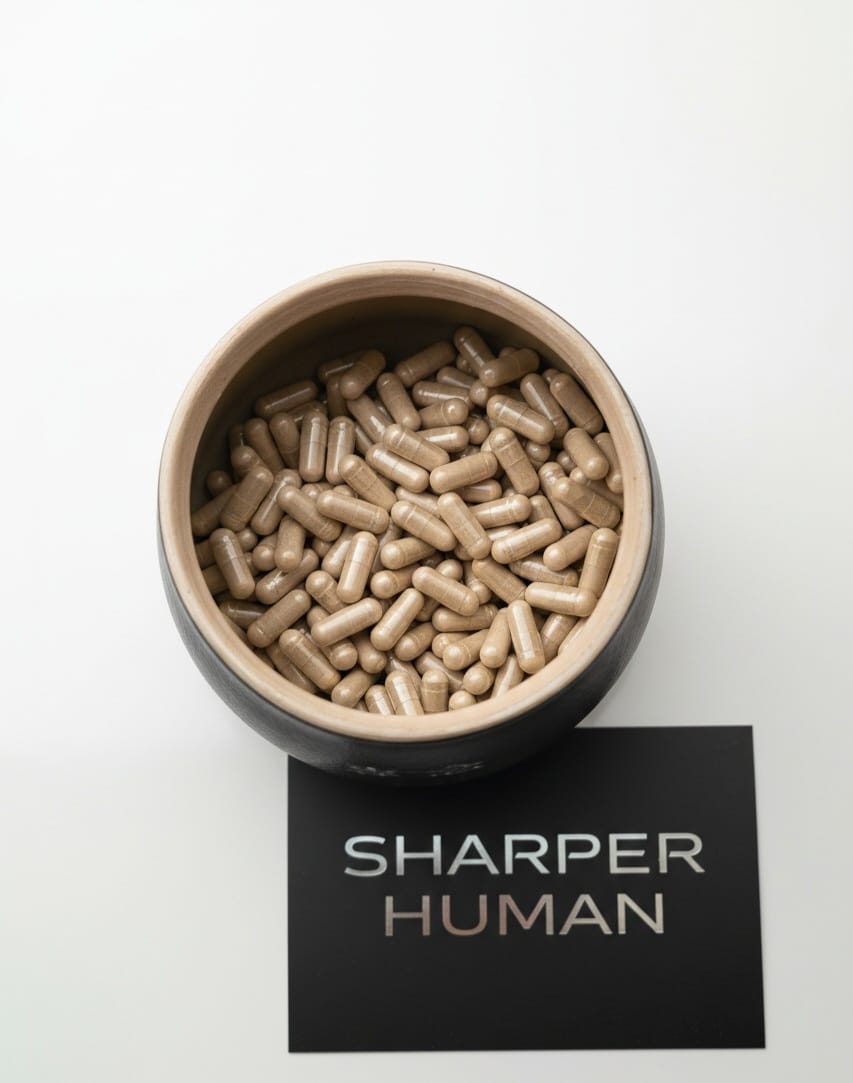
Buy on Amazon UKSharper Human supports the acetylcholine system primarily through Citicoline (300mg) — a well-absorbed choline source that supplies the raw material for acetylcholine and has strong human research specifically on attention, directly aligned with supporting focus and memory. Citicoline is complemented by the broader formula: Bacopa Monnieri (which interacts with cholinergic and other systems in supporting memory), Lion's Mane (supporting neuronal health), and the full B-complex supporting the cofactors behind neurotransmitter production. By supplying well-absorbed choline as the foundation, the formula supports healthy acetylcholine production for the attention and memory that focus depends on. This central focus on the acetylcholine system, alongside support for dopamine and other systems, reflects the evidence-led logic behind all 20 ingredients, detailed in the ingredients and dosages guide.
The honest bottom line: acetylcholine is the key neurotransmitter for memory and attention, supported most fundamentally by ensuring adequate well-absorbed choline — which is exactly how Sharper Human supports it, through Citicoline (300mg) and a complementary formula. Understanding acetylcholine illuminates how focus support works. Sharper Human is available on Amazon in the UK, with US availability planned.
References & further reading
- Nakazaki E, Mah E, Sanoshy K, et al. Citicoline and Memory Function in Healthy Older Adults: A Randomized, Double-Blind, Placebo-Controlled Clinical Trial. The Journal of Nutrition. 2021. doi:10.1093/jn/nxab119. View source ↗
- Kongkeaw C, Dilokthornsakul P, Thanarangsarit P, et al. Meta-analysis of randomized controlled trials on cognitive effects of Bacopa monnieri extract. Journal of Ethnopharmacology. 2014;151(1):528–535. View source ↗
- Docherty S, Doughty FL, Smith EF. The Acute and Chronic Effects of Lion’s Mane Mushroom Supplementation on Cognitive Function, Stress and Mood in Young Adults. Nutrients. 2023;15. View source ↗
- Peer-reviewed research on acetylcholine focus — PubMed, U.S. National Library of Medicine. View source ↗