GABA is the brain's main calming (inhibitory) neurotransmitter, so the logic behind GABA supplements seems obvious: take GABA, feel calmer. But the reality is more complicated and more interesting — there is a genuine scientific question about whether oral GABA even reaches the brain, which is central to evaluating these popular "calm" supplements. This is an honest look at GABA, the blood-brain-barrier problem, what the evidence actually shows, and why Sharper Human supports calm and focus through better-established means. This article is informational and not medical advice.
Key Takeaways
What GABA Is
GABA (gamma-aminobutyric acid) is the primary inhibitory neurotransmitter in the brain — essentially the main "brake" that calms neural activity, balancing the excitatory signals that ramp it up. Healthy GABA signalling is associated with calm, relaxation and reduced anxiety, and many calming medications work by enhancing GABA activity in the brain. Given this central calming role, GABA is sold widely as a supplement marketed for relaxation, stress and sleep, on the intuitive premise that supplementing the calming neurotransmitter should produce calm. It is this intuitive premise that makes GABA supplements popular — and it is precisely this premise that the science complicates, because the brain is protected by a barrier that does not let every molecule through, GABA included.
The Blood-Brain-Barrier Problem
The central scientific issue with GABA supplements is the blood-brain barrier — the protective filter that controls which substances pass from the bloodstream into the brain. There is a long-standing and genuine scientific question about whether GABA taken orally can cross this barrier effectively, with much of the conventional understanding suggesting it crosses poorly, if at all. If oral GABA largely cannot reach the brain, then the intuitive premise ("take GABA, raise brain GABA, feel calm") breaks down, because the supplemental GABA may simply not get to where it would need to act. This is the crux of the debate around GABA supplements, and it is an unusually clear example of why a mechanism that sounds obvious ("supplement the calming neurotransmitter") may not work as assumed once the body's actual barriers are considered.
What the Evidence Actually Shows
The evidence on GABA supplements is genuinely mixed, reflecting this uncertainty. Some studies do report relaxation or stress-related effects from GABA supplementation, while the blood-brain-barrier question casts doubt on whether these come from GABA directly raising brain levels. Several explanations have been proposed for any genuine effects: GABA may act on the enteric nervous system (the gut's nervous system, which communicates with the brain) rather than entering the brain directly; some effects may involve expectation or placebo; and there is ongoing research and debate about whether certain conditions or formulations change the picture. The honest summary is that GABA supplements sit in a genuinely uncertain, contested space — not clearly effective for directly calming the brain, with any real effects possibly working through indirect routes. This uncertainty is the key consideration for whether to rely on them.
GABA vs Things That Reliably Affect It
It is worth contrasting GABA supplements with substances that reliably do affect the GABA system, because the difference is instructive. Calming medications and certain compounds work by modulating GABA receptors in the brain — a different and more reliable mechanism than trying to supply GABA itself from outside. Notably, the compound phenibut crosses into the brain and acts on the GABA system, which is exactly why it has real (and dependence-forming, dangerous) effects — a stark reminder that genuinely affecting brain GABA is powerful and not without serious risk. By contrast, plain GABA supplements occupy the uncertain middle ground: marketed on the GABA system but of doubtful direct brain action. This contrast highlights why simply supplementing a neurotransmitter is not a reliable route to influencing it, and why better-established calming ingredients are a sounder choice.
Better-Established Routes to Calm
For supporting calm and a relaxed kind of focus, there are ingredients with clearer rationales than plain GABA. L-Theanine promotes relaxed alertness with a reasonable evidence base, as the L-Theanine guide covers; Taurine contributes to calm, stable neural signalling; the adaptogen Rhodiola supports resilience to stress; and magnesium supports the nervous system. These work through mechanisms that are better characterised than the uncertain oral-GABA route. And the genuinely powerful levers for calm remain non-supplemental: sleep, exercise, breathing practices and stress management, with clinical anxiety being a matter for professional support. The guide to the best herbs and adaptogens covers the calming botanicals worth considering ahead of a supplement whose core mechanism is in doubt.
Why Sharper Human Uses Taurine and Rhodiola
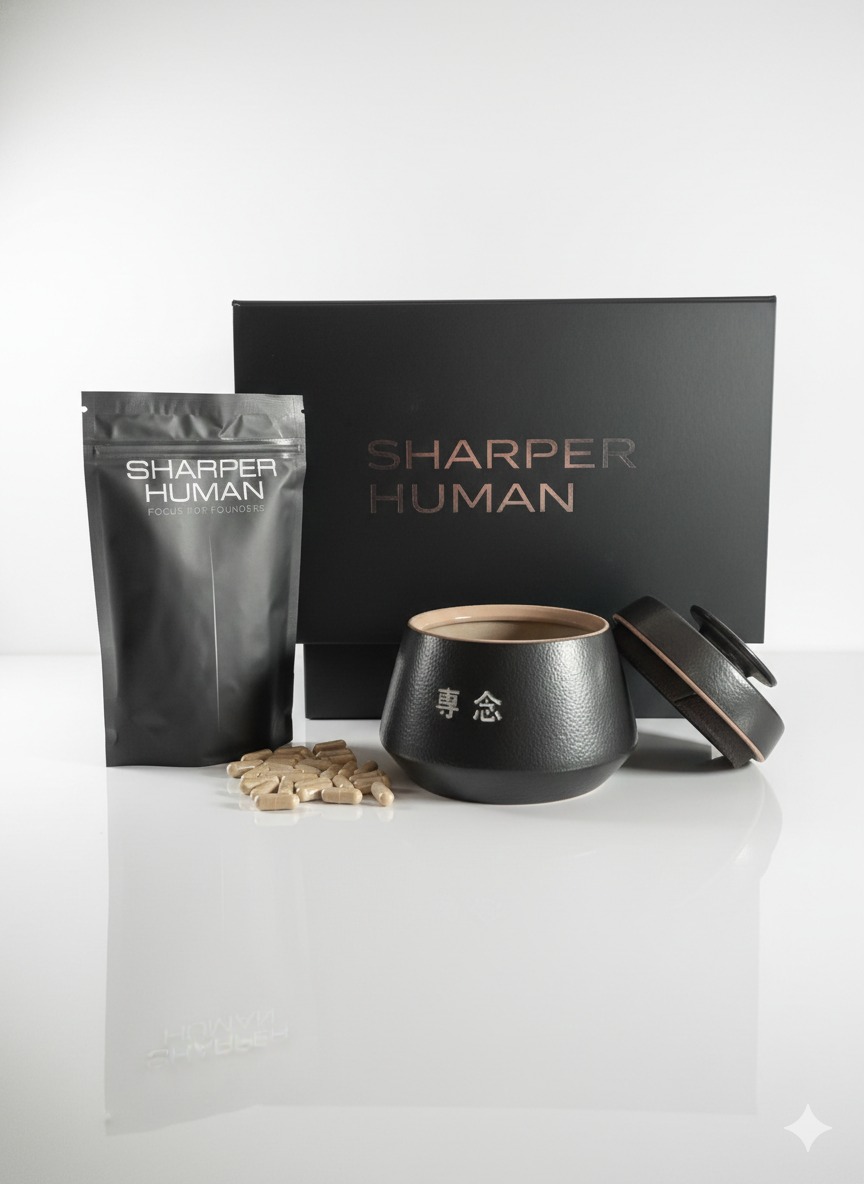
Focus for Founders.
An all-natural brain performance supplement. 20 research-backed ingredients. No caffeine. No stimulants.
Buy on Amazon UKSharper Human does not include GABA, and the reasoning is the genuine scientific uncertainty over whether oral GABA reaches the brain effectively. Rather than rely on an ingredient whose core mechanism is in doubt, the formula supports calm and composed focus through better-established means: Taurine (500mg) for calm, stable neural signalling, and Rhodiola (150mg) for resilience to stress — ingredients with clearer rationales for the daytime calm that aids focus. Choosing ingredients with sound, established mechanisms over one with a questionable delivery route is part of the evidence-led logic behind all 20 ingredients, detailed in the ingredients and dosages guide. GABA supplements are popular and intuitive, but the blood-brain-barrier question makes them a poor bet relative to better-supported options.
The honest bottom line: GABA supplements rest on an intuitive premise that the blood-brain barrier may undermine, since oral GABA appears to reach the brain poorly — so the evidence is genuinely mixed, and Sharper Human supports calm through better-established Taurine and Rhodiola instead. Sharper Human is available on Amazon in the UK, with US availability planned.
References & further reading
- Punja S, Shamseer L, Olson K, Vohra S. Rhodiola rosea for Mental and Physical Fatigue in Nursing Students: A Randomized Controlled Trial. PLoS One. 2014;9(9):e108416. View source ↗
- Owen GN, Parnell H, De Bruin EA, Rycroft JA. The combined effects of L-theanine and caffeine on cognitive performance and mood. Nutritional Neuroscience. 2008;11(4):193–198. View source ↗
- Peer-reviewed research on gaba calm focus — PubMed, U.S. National Library of Medicine. View source ↗