Productivity is less about working harder and more about protecting the conditions that let you do focused, meaningful work — and most of those conditions are about attention, energy and systems rather than willpower. This is a practical, evidence-based guide to being more productive: the time-management systems that hold up, the focus techniques worth using, how to manage energy rather than just time, and how to design an environment that makes good work easier. A focus supplement like Sharper Human can support the underlying cognition, but the habits below do the heavy lifting.
Key Takeaways
1. Protect Deep Work — the Biggest Lever
The single most valuable productivity habit is protecting uninterrupted blocks for focused, cognitively demanding work. Research on attention is clear that switching between tasks carries a real cost — each interruption forces the brain to reload context, and it can take many minutes to fully refocus. The practical move is time-blocking: scheduling protected windows for your most important work and defending them from meetings, messages and the temptation to multitask. A few hours of genuine deep work usually produces more than a whole day of fragmented, reactive effort.
2. Manage Energy, Not Just Time
Time-management advice often ignores that attention is not uniform across the day. Most people have peak cognitive hours — frequently in the morning — when demanding work goes best, and troughs when it does not. Matching your hardest work to your peak energy, and routine or administrative tasks to your troughs, is more effective than treating every hour as interchangeable. Energy is also physical: sleep, food and movement set the ceiling on how much focus is even available, which is why the foundations below are not separate from productivity but central to it.
3. Design Your Environment
Willpower is an unreliable tool against a distracting environment, so the smarter approach is to design distraction out. Keeping the phone in another room, using website blockers during deep-work blocks, and clearing the physical workspace all reduce the friction of focusing far more reliably than resolving to "try harder". The principle is to make the focused choice the easy default and the distracting choice the effortful one.
4. Use Focus Intervals and Real Breaks
Sustained concentration is easier in structured intervals than in open-ended marathons. Techniques like working in focused blocks of, say, 25 to 90 minutes followed by genuine breaks help maintain quality and prevent the slow degradation of attention that comes with grinding without rest. The key is that breaks be real — a short walk, daylight, or simply stepping away from screens — rather than a swap from work-screen to phone-screen, which does not restore attention.
5. Get the Foundations Right
None of the techniques above work on a depleted brain. Sleep is the master variable: even modest sleep loss measurably shrinks attention, working memory and motivation. Regular exercise supports focus and mood and is one of the best-evidenced cognitive habits. Hydration matters more than people expect, since even mild dehydration slows cognitive processing. And stable blood sugar — protein and slow carbohydrates over sugary snacks — avoids the energy crashes that derail an afternoon. These are not productivity extras; they are the substrate everything else runs on.
6. Beat Procrastination by Lowering the Barrier to Start
Much of what feels like a productivity problem is really a starting problem — procrastination is less about laziness than about the friction and emotional resistance of beginning a daunting task. The most reliable fixes lower that barrier to entry. Breaking a large, vague task into a small, concrete first step makes starting almost trivial: "write the report" is paralysing, but "open the document and write one rough paragraph" is not. Committing to just a few minutes often dissolves the resistance entirely, because starting is the hard part and momentum tends to carry you onward once you have begun. Reducing the decisions involved — planning tomorrow's priorities the evening before, so you wake up knowing exactly what to do first — removes the morning friction where good intentions so often stall.
It also helps to be strategic about when you tackle resistance-heavy work, pairing it with your peak energy rather than attempting it when you are already depleted, and to remove the easy escape routes — the phone, the open browser tabs — that procrastination reaches for. None of this requires willpower heroics; it works by making the first step small and the distractions inconvenient. Combined with the deep-work, energy and environment habits above, lowering the cost of starting is often the difference between a productive day and a frustrating one.
Where a Supplement Fits
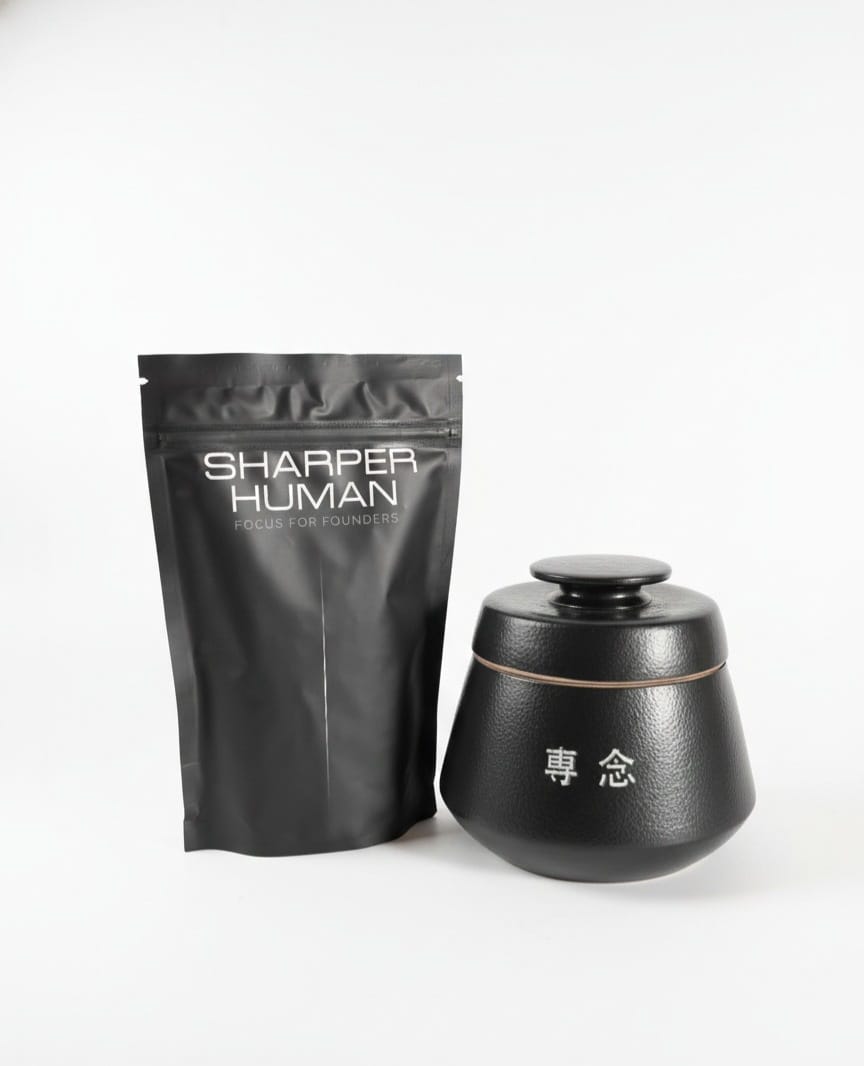
Focus for Founders.
An all-natural brain performance supplement. 20 research-backed ingredients. No caffeine. No stimulants.
Buy on Amazon UKOnce the systems, environment and foundations are in place, a focus supplement can support the underlying cognition. Sharper Human is caffeine-free and built around sustained attention and drive — L-Tyrosine (350mg) for motivation across task-switching, Citicoline (300mg) for attention, Rhodiola (150mg) for fatigue resistance and a full B-complex for mental energy — so it supports a long working day without a stimulant crash, and without disrupting the sleep that productivity depends on. At around £79 per month it consolidates these ingredients into one daily serving. The honest framing, though, is the one running through this guide: it is a supporting layer, not a substitute for deep-work blocks, energy management, a distraction-free environment and good sleep.
Put simply, productivity is built by protecting attention and energy, designing the environment, and getting the foundations right — then, if it helps, supporting the cognition with a transparent stack. Sharper Human is available on Amazon in the UK, with US availability planned.
References & further reading
- Nakazaki E, Mah E, Sanoshy K, et al. Citicoline and Memory Function in Healthy Older Adults: A Randomized, Double-Blind, Placebo-Controlled Clinical Trial. The Journal of Nutrition. 2021. doi:10.1093/jn/nxab119. View source ↗
- Punja S, Shamseer L, Olson K, Vohra S. Rhodiola rosea for Mental and Physical Fatigue in Nursing Students: A Randomized Controlled Trial. PLoS One. 2014;9(9):e108416. View source ↗
- Peer-reviewed research on more productive — PubMed, U.S. National Library of Medicine. View source ↗