
A supplement label contains everything you need to judge a product properly — but only if you know how to read it. Learning to decode serving sizes, ingredient amounts, proprietary blends, ingredient forms and quality markers turns you from a buyer reliant on marketing into one who can assess a product on its actual contents. This is a practical guide to reading a supplement label: understanding the key elements, spotting red flags like proprietary blends and underdosing, checking forms and fillers, and what quality markers to look for. This article is informational and not medical advice.
Key Takeaways
Start With the Serving Size
The first thing to check on any supplement label is the serving size — how many capsules (or how much) constitutes one serving — because everything else on the label refers to that serving, and it has important practical implications. A label might list impressive ingredient amounts, but if those are per a serving of several capsules, you need to take all of them to get those amounts. Checking the serving size tells you how many capsules you actually need to take daily, and lets you correctly interpret the ingredient amounts (which are per serving, not per capsule). It also relates to value and practicality: a product requiring many capsules per serving means a pouch or bottle lasts fewer servings (affecting cost per day), and some people find taking many capsules less convenient. So always start by identifying the serving size, then read the ingredient amounts in that context — this is the foundation for correctly understanding the rest of the label, and a common source of confusion when overlooked.
The Ingredient Amounts Are Everything
The single most important part of a supplement label is the ingredient amounts — the actual dose of each ingredient per serving — because this determines whether a product will genuinely be effective. An ingredient is only useful at an effective dose, so seeing the specific amount of each ingredient (e.g. how many milligrams) lets you judge whether it is present at a meaningful, research-backed level or merely a token amount. This is where you assess whether a product is properly dosed: comparing the listed amounts against the doses used in research for each ingredient reveals whether the product delivers effective amounts or is underdosed. A product can contain all the "right" ingredients but be useless if they are underdosed. So the ingredient amounts are everything — they are how you judge a product's likely effectiveness, far more informative than the ingredient names alone or the marketing. A transparent label that clearly lists the amount of every ingredient is essential for this assessment, which is why dose transparency matters so much, as the guide to choosing a nootropic stresses.
Spotting Proprietary Blends
A critical red flag to spot on a label is the proprietary blend — and learning to recognise it is essential. A proprietary blend appears on a label as a named blend (often with a trademarked-sounding name) listing several ingredients together, but disclosing only the total weight of the blend rather than the individual amount of each ingredient. This is a red flag because it hides exactly the information you most need — the dose of each ingredient — making it impossible to know whether each is present at an effective amount or a token sprinkle, and conveniently concealing underdosing, as the guide to avoiding proprietary blends explains in depth. When you see a label listing a blend with only a total weight (not individual doses), recognise that the product is withholding key information. The better products disclose every ingredient's individual dose, with no proprietary blends — full transparency. So scanning a label for proprietary blends (versus full individual-dose disclosure) is one of the most useful things you can do to assess a product's quality and trustworthiness.
Understanding %NRV and Ingredient Forms
Two more useful elements to understand are %NRV/%DV and ingredient forms. For vitamins and minerals, labels show a percentage — %NRV (Nutrient Reference Value, used in the UK/EU) or %DV (Daily Value, used in the US) — indicating how much of the recommended daily intake a serving provides, which helps you judge whether a nutrient is at a meaningful level relative to requirements (e.g. a B-vitamin at a substantial percentage of the NRV). Ingredient forms also matter: the specific form of an ingredient affects its quality and absorption (for example, different forms of a mineral or a choline source vary in bioavailability), so labels listing specific, quality forms (rather than vague or cheap ones) are a good sign. For herbal ingredients, look for standardisation (e.g. an extract standardised to a certain percentage of active compounds) and extract ratios, which indicate quality and potency. Understanding %NRV (for nutrient levels) and ingredient forms (for quality and absorption) adds further depth to reading a label beyond just the amounts, helping you assess not just how much but what quality of each ingredient a product provides.
Checking Fillers and Quality Markers
Finally, check the "other ingredients" and look for quality markers. The "other ingredients" section lists non-active components — capsule materials, fillers, binders, flow agents and so on. Some of these are normal and necessary (capsules need to be made of something), but a long list of unnecessary fillers, artificial additives or low-quality excipients can be a minor negative, while a clean formula with minimal unnecessary additives is a positive. Also look for quality markers: indications of manufacturing standards (such as production in a certified facility, like GMP or, for example, UK BRC standards), third-party testing, and clear labelling of allergens and suitability (vegan, etc.). These markers indicate quality and trustworthiness in manufacturing. So beyond the active ingredients, scanning the other ingredients (for unnecessary fillers) and looking for quality and manufacturing markers rounds out your assessment of a product's quality. Together with the serving size, ingredient amounts, transparency (no proprietary blends), %NRV and ingredient forms, this gives you a complete picture from the label alone — turning you into an informed buyer who can judge a product on its actual contents.
Putting It Into Practice With a Transparent Label
Focus for Founders.
An all-natural brain performance supplement. 20 research-backed ingredients. No caffeine. No stimulants.
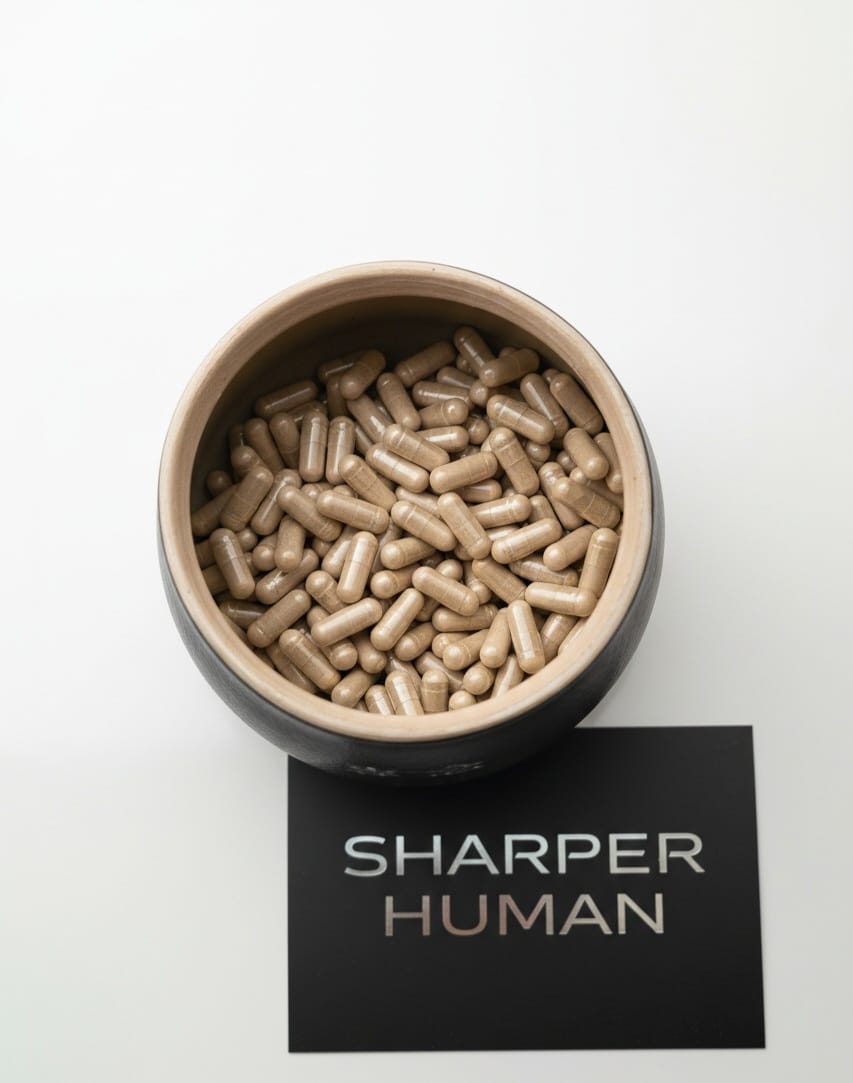
Buy on Amazon UKPutting these label-reading skills into practice, a good, transparent label is easy to assess — and Sharper Human's label is designed to be exactly that. It lists every one of its twenty ingredients with the individual dose of each (no proprietary blends), so you can verify each is at a sensible, meaningful amount — for example, Citicoline at 300mg, Bacopa at 150mg standardised to 84mg of bacosides, Lion's Mane as a 1000mg 5:1 extract, L-Tyrosine at 350mg, and so on, with the vitamins showing their %NRV. It uses specified quality forms and standardised extracts, discloses the serving size (the daily capsules), and is made to UK BRC AA standards. So applying the label-reading approach to Sharper Human reveals full transparency, sensible disclosed doses, quality forms, and good manufacturing standards — exactly what an informed buyer looks for, as detailed in the ingredients and dosages guide. This is the kind of transparent label that lets you assess a product properly, in contrast to one hiding doses in proprietary blends.
The honest bottom line: reading a supplement label means checking the serving size, scrutinising the individual ingredient doses (everything hinges on these), spotting proprietary blends (a red flag), and assessing %NRV, ingredient forms and quality markers — turning you into an informed buyer. A transparent label like Sharper Human's discloses every dose for exactly this assessment. Sharper Human is available on Amazon in the UK, with US availability planned.
References & further reading
- Nakazaki E, Mah E, Sanoshy K, et al. Citicoline and Memory Function in Healthy Older Adults: A Randomized, Double-Blind, Placebo-Controlled Clinical Trial. The Journal of Nutrition. 2021. doi:10.1093/jn/nxab119. View source ↗
- Kongkeaw C, Dilokthornsakul P, Thanarangsarit P, et al. Meta-analysis of randomized controlled trials on cognitive effects of Bacopa monnieri extract. Journal of Ethnopharmacology. 2014;151(1):528–535. View source ↗
- Docherty S, Doughty FL, Smith EF. The Acute and Chronic Effects of Lion’s Mane Mushroom Supplementation on Cognitive Function, Stress and Mood in Young Adults. Nutrients. 2023;15. View source ↗
- Peer-reviewed research on read label — PubMed, U.S. National Library of Medicine. View source ↗