
Lutein is best known as an eye-health nutrient, but it has a genuine and growing connection to the brain too — and in a world where most of us stare at screens for hours, the case for ensuring adequate lutein is stronger than ever. It is one of the ingredients that quietly earns its place in a cognitive formula for a screen-using audience. This is an honest look at what lutein does for the eyes and brain, why screen time makes it relevant, and why Sharper Human includes it at a meaningful dose. This article is informational and not medical advice.
Key Takeaways
What Lutein Is
Lutein is a carotenoid — a yellow-orange plant pigment in the same broad family as beta-carotene — found in dark leafy greens, egg yolks and other colourful foods. What makes it special is where the body puts it: lutein, together with its partner zeaxanthin, is selectively concentrated in the macula, the central part of the retina responsible for sharp vision, where the two form what is called the macular pigment. The body cannot make lutein, so it must come from diet or supplements. This selective accumulation in the eye is a strong clue that lutein plays a genuine functional role there, rather than being a generic antioxidant — and that role turns out to be protective in ways that matter for modern life.
The Eye-Health Evidence
Lutein's eye-health credentials are among the best-established of any supplement nutrient. The macular pigment it forms filters high-energy blue light and acts as an antioxidant in the retina, and lutein has substantial research for supporting long-term eye health and protecting against age-related decline in vision, with large studies underpinning its role. It is also studied in the context of visual strain and performance. This is a nutrient whose primary benefit is genuinely well supported, not speculative — a relatively rare thing in the supplement world. For a comparison with another eye-relevant carotenoid, the guide to astaxanthin covers how the two differ, with lutein being the better-established macular-pigment nutrient.
Why Screens Make Lutein Relevant
The eye-health case becomes especially pertinent in the context of modern screen use. Most knowledge workers, students and professionals now spend many hours a day looking at screens, which emit blue light and contribute to digital eye strain. Because lutein helps form the macular pigment that filters blue light and supports the eyes, ensuring adequate lutein is increasingly relevant for the screen-heavy lives most people lead — exactly the audience that uses a focus supplement. This is a genuinely modern rationale: a nutrient long valued for age-related eye health has new relevance for younger, screen-bound knowledge workers. It does not replace sensible screen habits — breaks, distance, lighting — but it supports the eyes that focus-oriented work relies on.
The Emerging Brain Connection
Beyond the eyes, lutein has a developing connection to the brain that adds to its interest for a cognitive formula. Lutein is found in brain tissue, where, like in the eye, it appears to act as an antioxidant, and a growing body of research has explored associations between lutein status and cognitive performance, particularly in older adults. The evidence here is more emerging than the rock-solid eye-health data, so it should be framed honestly as a promising secondary benefit rather than a primary claim. But the combination is appealing: a nutrient with strong eye-health evidence, particular relevance for screen users, and a plausible, developing cognitive link — which makes it a sensible inclusion in a formula for focus-oriented people.
Getting Lutein From Food
As with any nutrient, food comes first. The richest dietary sources of lutein are dark leafy greens — kale and spinach especially — along with egg yolks (where the lutein is particularly well absorbed thanks to the accompanying fat), and other colourful vegetables. The best foods for brain health guide covers these. The practical reality, though, is that many people eat too few leafy greens to reach the lutein intakes associated with benefit, which is where supplementation has a sensible role. Because lutein is fat-soluble, it is better absorbed with some dietary fat — another reason taking a lutein-containing supplement with a meal makes sense. Food-first, supplement-to-fill-the-gap is the right principle here, as with most nutrients.
Why Sharper Human Includes It
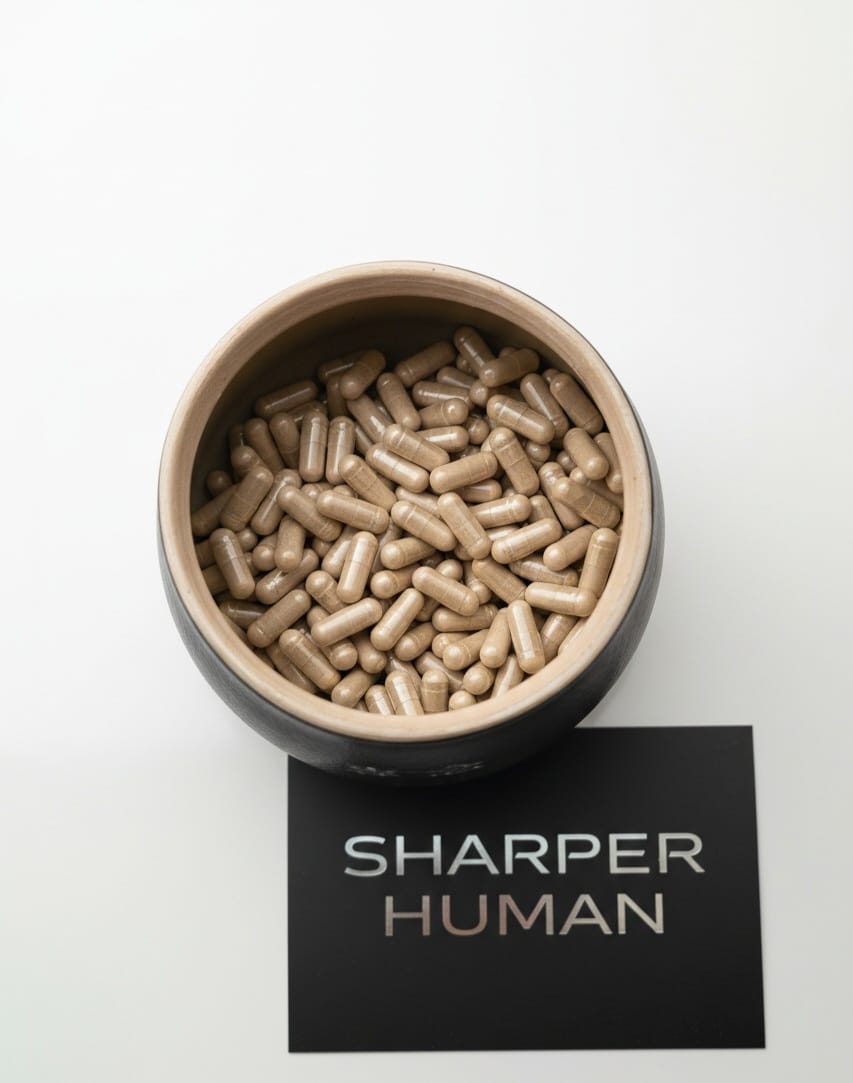
Focus for Founders.
An all-natural brain performance supplement. 20 research-backed ingredients. No caffeine. No stimulants.
Buy on Amazon UKSharper Human includes lutein at 21mg, and the reasoning fits the formula's audience-aware, evidence-led approach. The people who use a focus supplement spend long hours on screens, lutein has strong evidence for supporting the eyes against blue light and strain, and it carries a promising emerging link to cognition — so it earns its place as a nutrient that supports both the eyes that focus-oriented work depends on and, plausibly, the brain itself. It sits alongside Bilberry (120mg of a 15:1 extract) for complementary antioxidant and eye support, within the broader cognitive formula. This is the same fit-for-purpose logic behind all 20 ingredients, detailed in the ingredients and dosages guide. Lutein is a good example of an ingredient chosen for the real-world reality of how the audience lives and works.
The honest bottom line: lutein is a well-evidenced eye-health nutrient with particular relevance for screen users and a promising emerging link to cognition — which is exactly why Sharper Human includes 21mg. It supports the eyes and brain that focus-oriented work relies on, alongside sensible screen habits and a green-rich diet. Sharper Human is available on Amazon in the UK for around £79 per month, with US availability planned.
References & further reading
- Peer-reviewed research on lutein eye brain — PubMed, U.S. National Library of Medicine. View source ↗
- Suliman NA, Mat Taib CN, Mohd Moklas MA, et al. Establishing Natural Nootropics: Recent Molecular Enhancement Influenced by Natural Nootropic. Evidence-Based Complementary and Alternative Medicine. 2016. View source ↗