Melatonin is the body's "sleep hormone", and as a supplement it is one of the most popular sleep aids in the world — though in the UK it is regulated quite differently from the US. While good sleep is foundational to cognition, melatonin itself is a sleep-timing aid, not a focus supplement, and it comes with important regulatory and usage nuances. This is an honest look at what melatonin is, how it works, the UK-vs-US rules, why it is a sleep rather than focus aid, and how Sharper Human relates to sleep and focus. This article is informational and not medical advice.
Key Takeaways
What Melatonin Is
Melatonin is a hormone produced naturally by the brain's pineal gland, primarily in the evening and at night, that plays a central role in regulating the sleep-wake cycle — the circadian rhythm. As darkness falls, melatonin rises, signalling to the body that it is time to wind down and sleep; as morning approaches, it falls. So melatonin is essentially the body's internal "night-time" signal, governing sleep timing. As a supplement, melatonin is used to influence this timing — most usefully for situations where the circadian rhythm is disrupted, such as jet lag or shift work, and sometimes for certain sleep difficulties. It is one of the world's most popular sleep aids in places where it is sold over the counter. Melatonin is a genuine, important hormone with real effects on sleep timing — but two key points shape where it fits: it is a sleep aid (not a focus supplement), and its regulatory status differs markedly between countries, being prescription-only in the UK, both of which are central to understanding it.
How Melatonin Works
Melatonin works primarily as a circadian-rhythm signal rather than a sedative in the conventional sense, which is important for understanding its effects and best uses. Rather than knocking you out like a sleeping pill, melatonin signals to the body that it is night-time, helping to shift or reinforce the sleep-wake cycle and promote sleepiness at the appropriate time. This makes it particularly useful for circadian issues — adjusting to a new time zone (jet lag), or managing the misaligned schedule of shift work, as the guide to shift workers touches on — where the goal is to shift the body's clock. For these timing-related uses, melatonin can be genuinely helpful. It is generally less dramatically effective as a simple "sleeping pill" for ordinary insomnia (where the issue is not primarily circedian timing), though it is used for various sleep difficulties. Understanding melatonin as a circadian-timing signal clarifies that its strength is in addressing sleep-timing and rhythm issues, and that it works by reinforcing the body's night-time signalling rather than by sedation.
The UK-vs-US Regulatory Difference
A genuinely important practical point about melatonin is the significant regulatory difference between countries — a clear example of the UK-versus-US supplement divide. In the United States, melatonin is sold as an over-the-counter dietary supplement, widely available and hugely popular, so Americans can simply buy it. In the United Kingdom, by contrast, melatonin is a prescription-only medicine — it is not sold as an over-the-counter supplement here, and obtaining it requires a prescription from a doctor. This is a substantial difference: a product that is a casual supplement purchase in the US is a prescription medicine in the UK. This reflects the broader divergence in how the two regulatory systems classify certain substances (the US's more permissive dietary-supplement framework versus the UK/EU's more restrictive approach to certain compounds), as discussed in guides comparing UK and US supplement regulation. For anyone in the UK, the key takeaway is that melatonin is not an over-the-counter supplement option — it requires a prescription — which is essential to know and a notable instance of the regulatory differences between the two markets.
Sleep, Not Focus
A crucial point for understanding melatonin's place is that it is a sleep aid, not a focus or cognitive-enhancement supplement — the two serve opposite purposes. Melatonin promotes sleepiness and signals night-time, so it is taken in the evening to support sleep, and would be entirely counterproductive for daytime focus (taking melatonin when you need to be alert would promote sleepiness). So melatonin belongs firmly in the sleep category, not the focus category. That said, there is an indirect connection worth acknowledging: good sleep is foundational to cognition, so insofar as melatonin helps someone sleep better (particularly with circadian issues like jet lag or shift work), it could indirectly support next-day cognitive function via better sleep — but this is through improving sleep, not through any direct cognitive effect, and melatonin itself remains a sleep aid taken at night, not a daytime focus supplement. This distinction — melatonin supports sleep (which supports cognition indirectly), but is not itself a focus aid — clarifies that it addresses the sleep foundation rather than directly supporting focus, as the guide to nootropics and sleep covers.
Sensible Use and Considerations
For those who use melatonin (where legally available, or by prescription in the UK), a few sensible considerations apply. Melatonin is most useful for circadian-timing issues (jet lag, shift work) rather than as a routine sleeping pill, and timing and dose matter (it is generally taken at an appropriate evening time, and lower doses are often as effective as higher ones for circadian purposes). It is generally considered to have a reasonable short-term safety profile, but long-term use and effects, appropriate dosing, and individual responses are considerations best discussed with a doctor — particularly in the UK, where it is prescription-only and thus used under medical guidance anyway. As with any sleep aid, melatonin is best seen as a tool for specific situations alongside good sleep habits (sleep hygiene, consistent schedule, managing light exposure), rather than a substitute for them. The foundational approach to sleep — good habits, consistent timing, appropriate light exposure — does the heavy lifting, with melatonin as a situational aid for circadian issues, used sensibly and (in the UK) under prescription.
How Sharper Human Relates to Sleep and Focus
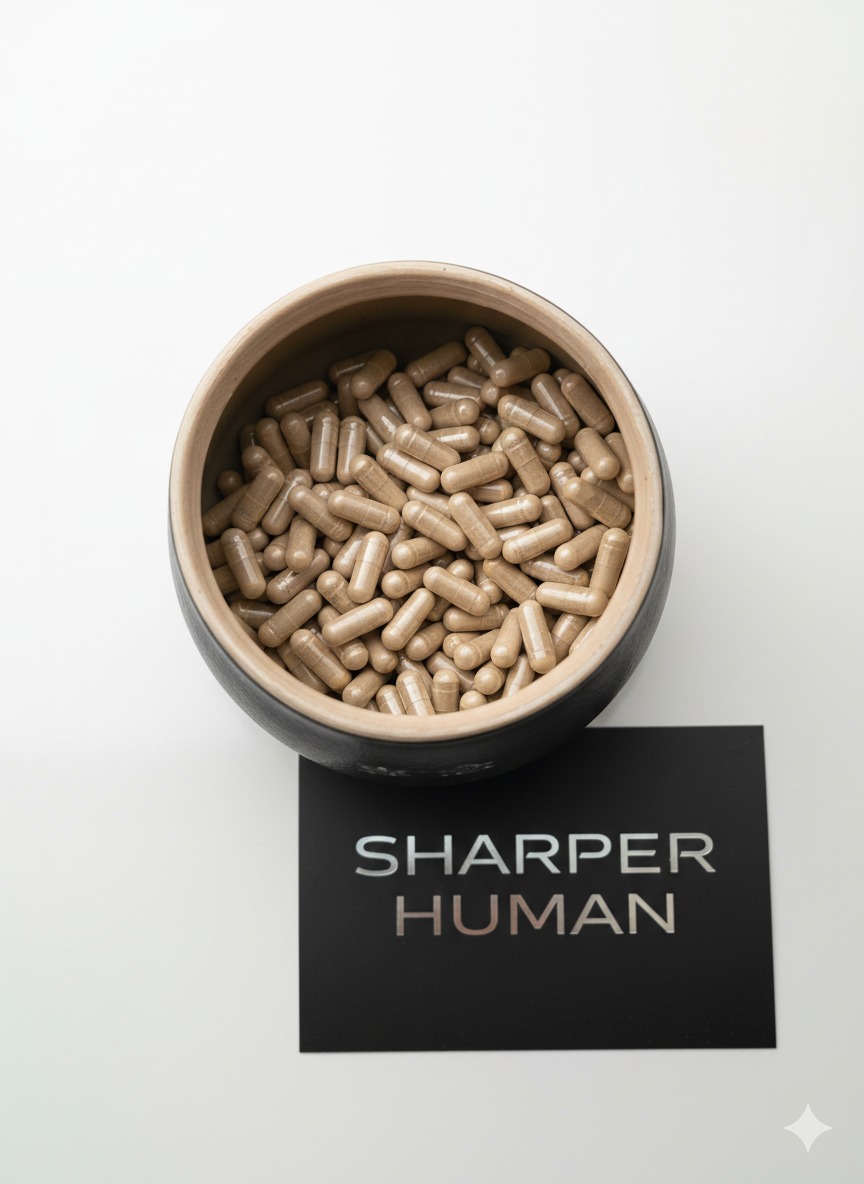
Focus for Founders.
An all-natural brain performance supplement. 20 research-backed ingredients. No caffeine. No stimulants.
Buy on Amazon UKSharper Human does not contain melatonin, and the reasoning is clear: melatonin is a sleep-timing aid (and a prescription-only medicine in the UK), not a daytime focus ingredient — so it has no place in a daytime focus formula. Sharper Human is designed to support focus and cognition during the day, and is caffeine-free, which means it supports daytime alertness without stimulants and, importantly, without anything that would disrupt sleep (no caffeine to interfere with the night's rest) — so it supports daytime focus while being compatible with good sleep. The honest framing is that good sleep (the foundation melatonin sometimes addresses for circadian issues) is supported through sleep habits and, where needed, appropriate medical guidance, while Sharper Human supports daytime focus on top of that foundation, as the guide to nootropics and sleep covers. This clear division — Sharper Human for daytime focus, good sleep practices for the sleep foundation — reflects the focused, fit-for-purpose design detailed in the ingredients and dosages guide. Melatonin is a sleep hormone for night-time; Sharper Human supports focus for the day.
The honest bottom line: melatonin is the body's sleep hormone, used mainly as a circadian-timing aid (jet lag, shift work) — and notably, it is prescription-only in the UK (unlike the over-the-counter US supplement) — and it is a sleep aid, not a focus supplement. Sharper Human supports daytime focus (caffeine-free, sleep-compatible) rather than sleep, and is available on Amazon in the UK, with US availability planned.
References & further reading
- Peer-reviewed research on melatonin sleep brain — PubMed, U.S. National Library of Medicine. View source ↗
- Suliman NA, Mat Taib CN, Mohd Moklas MA, et al. Establishing Natural Nootropics: Recent Molecular Enhancement Influenced by Natural Nootropic. Evidence-Based Complementary and Alternative Medicine. 2016. View source ↗