Quercetin is a plant flavonoid found in many fruits and vegetables, popular as a supplement for its antioxidant and anti-inflammatory properties, immune and allergy support, and sometimes marketed for brain health. It is a genuinely interesting compound with real properties, but like several antioxidants, its strongest evidence is general-health rather than focus-specific, and bioavailability is a recurring issue. This is an honest look at what quercetin does, where its evidence stands, the practical caveats, and why Sharper Human focuses on targeted cognitive ingredients instead. This article is informational and not medical advice.
Key Takeaways
What Quercetin Is
Quercetin is a flavonoid — a class of plant pigment antioxidant — found widely in foods such as onions, apples, berries, capers, and leafy greens, making it a normal part of a plant-rich diet. As a supplement, it is concentrated and marketed primarily for its antioxidant and anti-inflammatory properties, with popular uses including immune support and easing allergy symptoms (quercetin has effects relevant to histamine and allergic responses). It belongs to the same broad family of plant antioxidants as the anthocyanins in berries and other polyphenols. Quercetin is a genuine, well-studied compound with real biological activity — the question for our purposes is specifically how relevant it is to focus and cognition, and how its general antioxidant profile compares with the formulation priorities of a focus stack.
The Antioxidant and Anti-Inflammatory Evidence
Quercetin's core, genuinely-supported properties are antioxidant and anti-inflammatory, and these underpin most of its research. It combats oxidative stress and modulates inflammatory processes, which is the basis of its study in cardiovascular, metabolic, immune and allergy contexts, with some genuinely interesting findings in these general-health areas. Since chronic inflammation and oxidative stress are relevant to brain ageing, quercetin's properties give it a plausible, if indirect, brain-health rationale — supporting the antioxidant and anti-inflammatory environment in which the brain operates, much like other antioxidant compounds. This places quercetin among the general-health antioxidants with a plausible brain-supportive angle, rather than among ingredients with direct, demonstrated cognitive enhancement. Its strengths are real but lie largely in the general-health domain.
The Brain Evidence and the Bioavailability Catch
For the brain specifically, quercetin's evidence is early and limited. There is research interest in quercetin and brain health via its antioxidant and anti-inflammatory mechanisms, and some preclinical work, but robust evidence for meaningful cognitive enhancement in healthy people is lacking — it sits in the "plausible mechanism, limited direct human evidence" category common to antioxidant ingredients. Compounding this is a familiar catch: bioavailability. Quercetin is relatively poorly absorbed on its own, which raises questions about how much active compound reaches the body and brain at typical doses (various formulations aim to improve this). So quercetin's brain case faces the double challenge of limited direct cognitive evidence and absorption uncertainty — meaning that, despite its genuine antioxidant properties, it is far from a proven cognitive ingredient, and its inclusion in a focus formula would be hard to justify on the evidence.
The Antioxidant Selection Problem
Quercetin illustrates a broader formulation point about antioxidants: there are many antioxidant compounds — quercetin, resveratrol, curcumin, various berry extracts, CoQ10, astaxanthin and more — and a focus formula cannot and should not include them all, as doing so would be costly, redundant and unfocused. The sensible approach is to provide rounded antioxidant and brain-and-eye support through a thoughtful selection of well-chosen ingredients, rather than chasing every antioxidant on the market. The deep-dives on bilberry and turmeric illustrate this selectivity, with several antioxidants sharing quercetin's "promising general-health antioxidant with bioavailability questions" profile. The discipline is to choose antioxidant support purposefully and cost-effectively in service of the formula's focus-and-brain-health goal, rather than adding compounds simply for an appealing antioxidant label.
Where Quercetin Fits
For someone interested in quercetin's genuine benefits — antioxidant and anti-inflammatory support, immune or allergy contexts — a well-formulated quercetin supplement (ideally one addressing bioavailability) is a reasonable choice, or simply eating plenty of quercetin-rich foods like onions, apples and berries, as the best foods for brain health guide reflects. It sits among the general-health and antioxidant supplements rather than the targeted nootropics. As always, obtaining antioxidants largely from a colourful, varied diet is the sensible foundation, with concentrated supplements as a targeted addition for specific purposes. For brain health, supporting the antioxidant environment is genuinely valuable, but it is one part of a broader picture and is well covered by a few well-chosen ingredients rather than requiring every antioxidant compound.
Why Sharper Human Focuses Elsewhere
Focus for Founders.
An all-natural brain performance supplement. 20 research-backed ingredients. No caffeine. No stimulants.
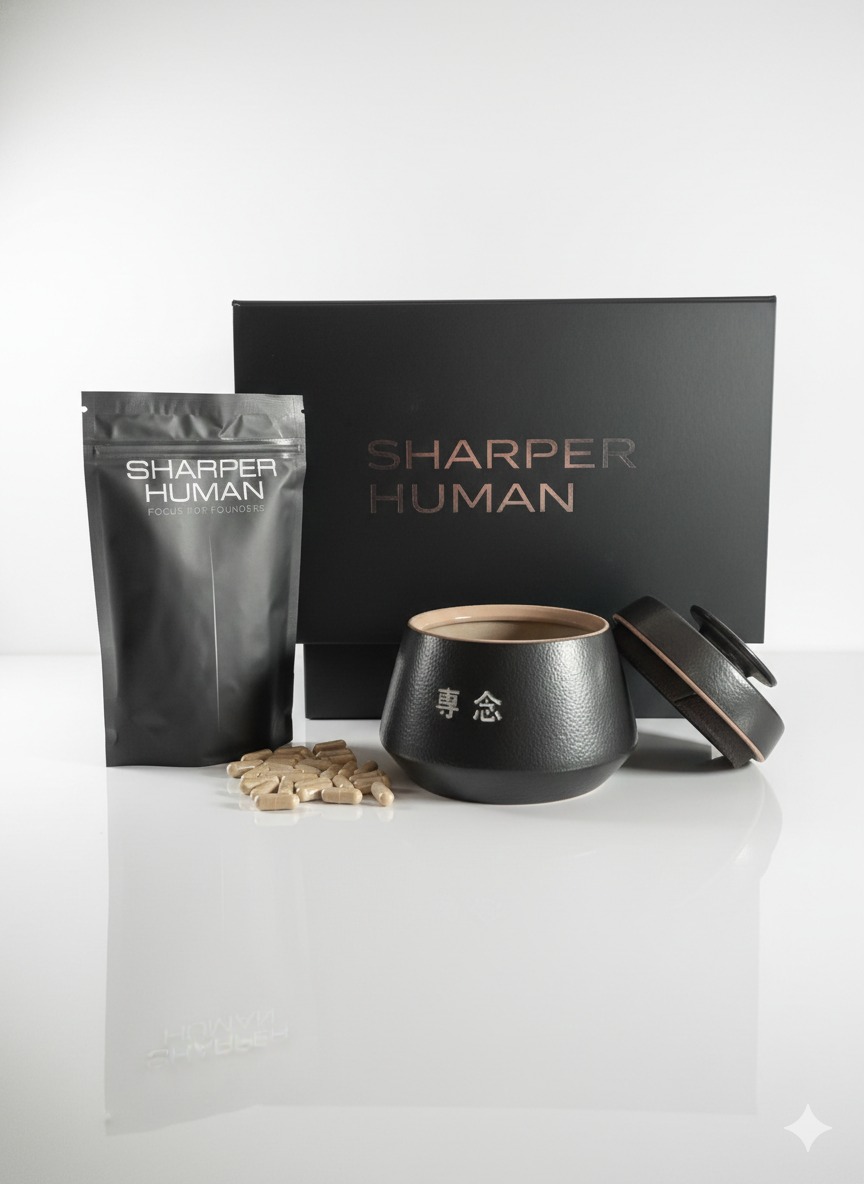
Buy on Amazon UKSharper Human does not include quercetin, and the reasoning is evidence, fit and value. Quercetin's strongest evidence is general-health antioxidant and anti-inflammatory rather than focus-specific cognitive enhancement, and its bioavailability is a challenge — so it is a poor use of capsule space relative to direct cognitive actives. For antioxidant and brain-and-eye support within its cognitive remit, the formula uses well-chosen ingredients like Bilberry (120mg of a 15:1 extract) and Lutein (21mg), while focusing its capsule space on direct cognitive ingredients like Citicoline, Bacopa and Lion's Mane. This is the fit-for-purpose, evidence-and-value-conscious logic behind all 20 ingredients, detailed in the ingredients and dosages guide. Quercetin is a genuinely useful general-health antioxidant — just not a targeted focus ingredient.
The honest bottom line: quercetin is a flavonoid with genuine antioxidant and anti-inflammatory properties and general-health uses, but limited direct cognitive evidence and bioavailability challenges mean a focus formula like Sharper Human sensibly provides antioxidant support through better-chosen ingredients and focuses elsewhere. Antioxidants are best obtained largely from a colourful diet. Sharper Human is available on Amazon in the UK, with US availability planned.
References & further reading
- Nakazaki E, Mah E, Sanoshy K, et al. Citicoline and Memory Function in Healthy Older Adults: A Randomized, Double-Blind, Placebo-Controlled Clinical Trial. The Journal of Nutrition. 2021. doi:10.1093/jn/nxab119. View source ↗
- Kongkeaw C, Dilokthornsakul P, Thanarangsarit P, et al. Meta-analysis of randomized controlled trials on cognitive effects of Bacopa monnieri extract. Journal of Ethnopharmacology. 2014;151(1):528–535. View source ↗
- Docherty S, Doughty FL, Smith EF. The Acute and Chronic Effects of Lion’s Mane Mushroom Supplementation on Cognitive Function, Stress and Mood in Young Adults. Nutrients. 2023;15. View source ↗
- Peer-reviewed research on quercetin brain inflammation — PubMed, U.S. National Library of Medicine. View source ↗