A common question from people exploring supplements is whether nootropics boost testosterone — often because the supplement world blurs the lines between cognitive enhancement, "vitality" and hormones. The honest answer is that cognitive nootropics are generally not testosterone boosters: they support brain function, which is a different thing from the hormonal system. This is an honest look at why nootropics and testosterone are different, the one ingredient with some hormonal research, the genuine role of stress and sleep, and why Sharper Human makes no hormonal claims. This article is informational and not medical advice; for any hormonal concerns, see a doctor.
Key Takeaways
The Honest Answer
The honest, direct answer to whether nootropics boost testosterone is: cognitive nootropics generally do not. Nootropics — at least in the proper sense of cognitive-supporting ingredients — work on the brain and cognition: supporting neurotransmitter systems (like acetylcholine and dopamine), brain-cell health, focus, memory and mental energy. Testosterone, by contrast, is a hormone, produced and regulated by an entirely different system (the endocrine system). These are two different domains — cognitive function and hormonal status — and supporting one does not inherently affect the other. So the genuine cognitive nootropic ingredients (citicoline, Bacopa, L-Tyrosine, Lion's Mane, and so on) are not testosterone boosters; they support brain function, not hormone production. Anyone expecting a cognitive nootropic to raise testosterone is conflating two separate things. This conflation is common because the supplement market often blurs cognition, "vitality", energy and hormones together in its marketing, but honestly, cognitive nootropics and testosterone-boosting are different categories — and the straightforward answer is that nootropics, as cognitive supplements, are not testosterone boosters.
Why Hormones and Cognition Are Different
Understanding why nootropics don't boost testosterone comes down to recognising that hormones and cognition are genuinely different systems with different mechanisms. Cognition is supported through the brain's neurotransmitter systems, cellular health and energy — the domain that cognitive nootropic ingredients address by supplying raw materials (like choline for acetylcholine, or tyrosine for dopamine) or supporting brain-cell function. Testosterone is a sex hormone produced mainly in the body's endocrine glands, regulated by a complex hormonal feedback system, and influencing the body in ways quite distinct from neurotransmitter function. Supporting the brain's neurotransmitter raw materials has no inherent effect on hormone production — they are separate physiological pathways. This is why the two should not be conflated: an ingredient that supports acetylcholine for focus is not thereby affecting testosterone, because acetylcholine and testosterone belong to different systems. The supplement market's tendency to bundle "focus, energy, vitality, hormones" into one marketing message obscures this genuine distinction. Honestly, cognitive support and hormonal status are different goals requiring different (if any) approaches, and a cognitive formula addresses the former, not the latter — which is the fundamental reason nootropics are not testosterone boosters, as the guide to the hormone DHEA also reflects in distinguishing hormones from cognitive ingredients.
The Ashwagandha Question
One ingredient deserves specific honest mention, because it is the partial exception that proves the rule: ashwagandha. Ashwagandha is an adaptogenic herb (sometimes used in nootropic and "vitality" products), and some research — particularly on standardised extracts like KSM-66, as the ashwagandha extract types guide covers — has explored effects on testosterone in certain populations (for example, some studies in specific groups of men), with some suggesting modest effects. However, several honest caveats are essential. First, this is a hormonal/adaptogenic effect, separate from cognitive enhancement — it relates to ashwagandha's adaptogenic and stress-related properties, not to "nootropic" cognitive support. Second, the effect is modest and specific to certain populations and contexts, not a dramatic or universal testosterone boost. Third, ashwagandha is a hormonally-active-leaning adaptogen that warrants its own caution (it can have effects on hormones and other systems, and is not suitable for everyone), as the guide to ashwagandha covers. So ashwagandha is the one common ingredient with genuine (if modest, population-specific) testosterone-related research — but this is an adaptogenic/hormonal matter, distinct from cognitive nootropic effects, and it does not make ashwagandha a reliable "testosterone booster" or change the general picture that cognitive nootropics don't boost testosterone. It is a specific, caveated exception, not the rule.
The Genuine Role of Stress and Sleep
There is one legitimate, indirect connection between the broader wellness picture and hormonal health worth honestly acknowledging: stress and sleep. Chronic stress (and the elevated stress hormones it involves) and poor sleep can negatively affect overall health, including aspects of hormonal health — so genuinely managing stress and getting good sleep support overall health and may be relevant to maintaining healthy hormonal function as part of general wellbeing. This means that the fundamentals — good sleep, stress management, exercise, and a healthy diet — support overall health, including hormonal health, far more meaningfully than any "testosterone booster" supplement. However, two honest points: this is an indirect effect via supporting overall health and healthy function (not a direct "boosting" of testosterone above normal), and it is achieved through the fundamentals (sleep, stress management, exercise, diet), not through a cognitive supplement per se. So insofar as anything in the wellness picture relates to healthy hormonal function, it is the fundamentals — particularly sleep and stress management, as the guide to sleep covers — rather than nootropics specifically. This reinforces the honest message: for hormonal health, the powerful levers are the lifestyle fundamentals (and, where there is a genuine medical concern, a doctor), not supplements marketed as testosterone boosters.
Be Wary of Testosterone-Boosting Claims
Given the popularity of the topic, an honest word of caution about the "testosterone booster" supplement market is warranted. This is a market full of products making bold testosterone-boosting claims, many of which rest on weak, preliminary or overstated evidence — ingredients are often included on thin rationale, doses may not match any research, and the dramatic marketing frequently outpaces what the evidence supports. So a healthy scepticism toward supplements marketed primarily as "testosterone boosters" or "test boosters" is sensible: many overpromise and underdeliver, and the category is prone to hype. This is not to say hormonal health is unimportant, but rather that supplement marketing in this space should be treated critically, and that genuine concerns about low testosterone are a medical matter best addressed with a doctor (who can properly assess and advise), not self-treated with over-hyped supplements. For anyone genuinely concerned about their testosterone or hormonal health, the responsible approach is a medical consultation — proper assessment and evidence-based guidance — rather than relying on supplement claims, as the general guidance on supplement safety and realistic expectations reflects. Honest scepticism toward bold hormonal claims protects both your money and your health.
Why Sharper Human Makes No Hormonal Claims
Focus for Founders.
An all-natural brain performance supplement. 20 research-backed ingredients. No caffeine. No stimulants.
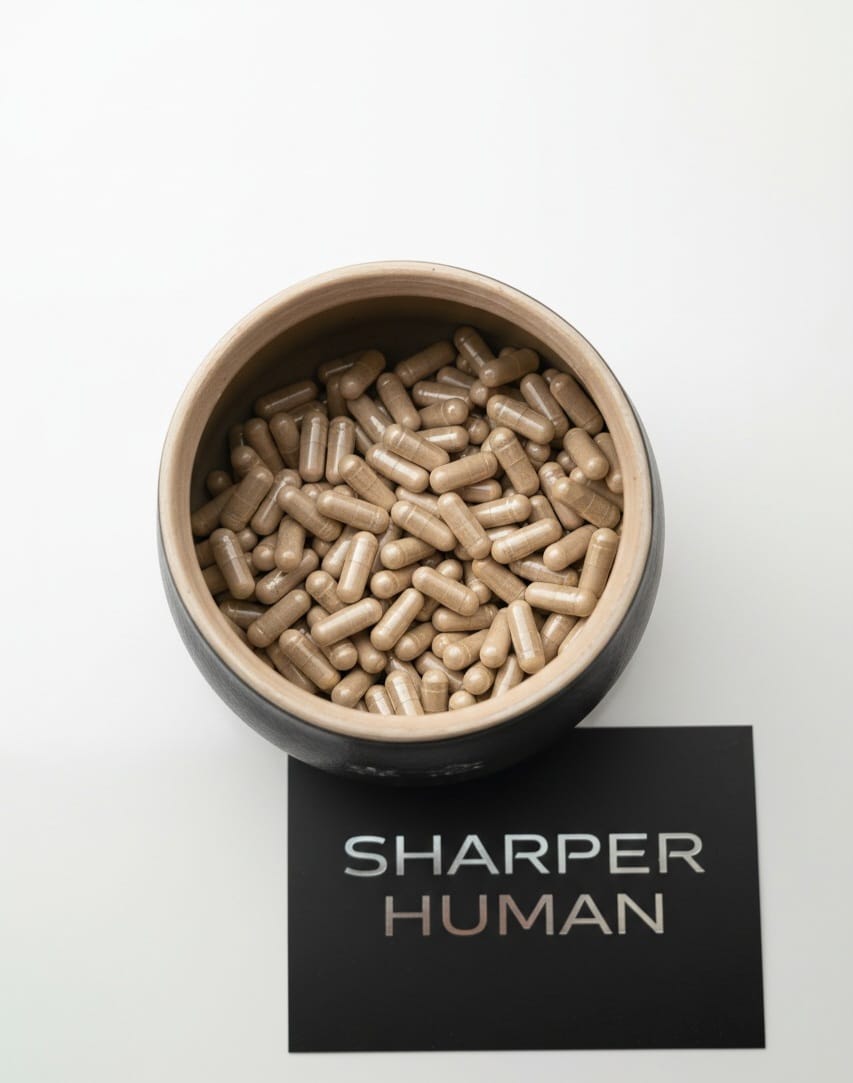
Buy on Amazon UKSharper Human is a cognitive focus formula, and it makes no testosterone or hormonal claims of any kind — a deliberate and important position. The reasoning follows everything above: Sharper Human is designed to support cognition (focus, memory, mental energy, drive) through well-evidenced cognitive ingredients — Citicoline, Bacopa, L-Tyrosine, Lion's Mane, Rhodiola and the rest — none of which is a hormone or a testosterone booster, and the formula contains no hormones whatsoever. Notably, it uses Rhodiola (an energising adaptogen) rather than ashwagandha as its adaptogen, as the Rhodiola versus ashwagandha comparison covers — so it does not include even the one common ingredient with testosterone-related research, keeping its focus squarely on cognition. The formula deliberately stays in its lane: cognitive support through safe, non-hormonal, well-evidenced ingredients, making no claims about testosterone, hormones or "vitality" in a hormonal sense. For anyone with hormonal concerns, the right step is a doctor, not a cognitive supplement. This clear boundary — cognitive support only, no hormonal content or claims — reflects the responsible, honest, fit-for-purpose logic behind all 20 ingredients, detailed in the ingredients and dosages guide. Sharper Human supports your mind, and makes no claims about your hormones.
The honest bottom line: cognitive nootropics are generally not testosterone boosters — cognition and hormones are different systems — with ashwagandha being a modest, caveated exception (an adaptogenic effect, separate from cognition). For hormonal health, the fundamentals (sleep, stress, exercise, diet) and a doctor matter, not "test booster" supplements. Sharper Human is a cognitive formula that contains no hormones and makes no hormonal claims, and is available on Amazon in the UK, with US availability planned.
References & further reading
- Nakazaki E, Mah E, Sanoshy K, et al. Citicoline and Memory Function in Healthy Older Adults: A Randomized, Double-Blind, Placebo-Controlled Clinical Trial. The Journal of Nutrition. 2021. doi:10.1093/jn/nxab119. View source ↗
- Kongkeaw C, Dilokthornsakul P, Thanarangsarit P, et al. Meta-analysis of randomized controlled trials on cognitive effects of Bacopa monnieri extract. Journal of Ethnopharmacology. 2014;151(1):528–535. View source ↗
- Punja S, Shamseer L, Olson K, Vohra S. Rhodiola rosea for Mental and Physical Fatigue in Nursing Students: A Randomized Controlled Trial. PLoS One. 2014;9(9):e108416. View source ↗
- Peer-reviewed research on boost testosterone — PubMed, U.S. National Library of Medicine. View source ↗